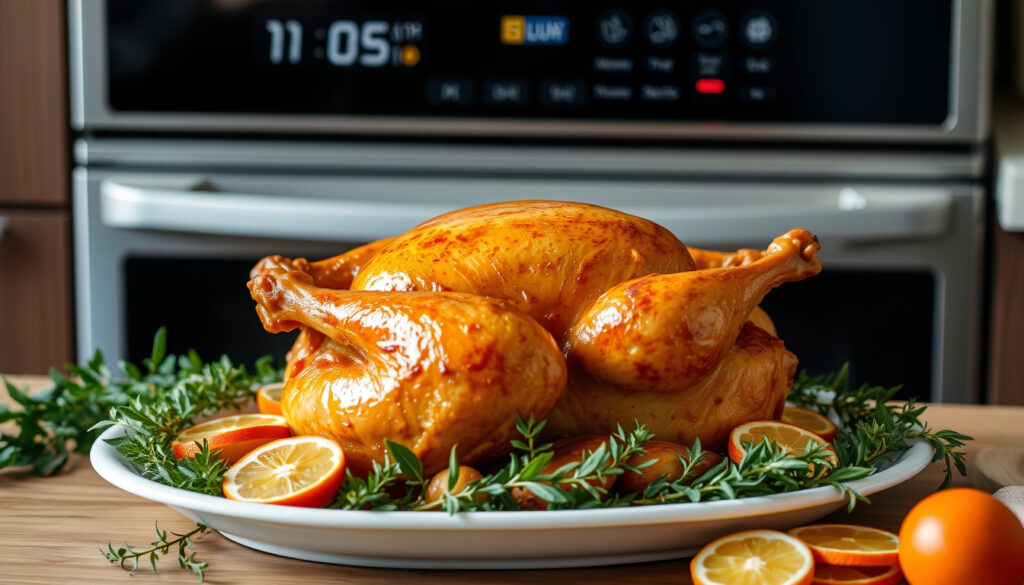
How to Cook a Turkey – 2025 Guide with Timing and Tip
Cooking a turkey for the first time can feel like a high-stakes operation. Between judging the weight, setting the right oven temperature, and knowing when it is actually safe to eat, there is plenty of room for error. This guide cuts through the noise with straightforward timing rules, temperature targets, and methods from trusted sources — whether you are roasting a whole bird, a crown, or just the breast.
The most important rule for any turkey cook is this: time is a guide, but temperature is the truth. A reliable meat thermometer removes the guesswork. According to the NHS / FSA – Turkey cooking safety guidelines, poultry must reach a safe internal temperature to be eaten. How long that takes depends on the size of the bird, the cut, and your oven.
In the sections below, you will find specific timings for whole turkeys, crowns, and breast portions, plus expert advice from Jamie Oliver and practical steps for beginners. No rinsing, no guessing — just clear, fact-based instructions.
How Long to Cook a Turkey Per Kg — The Essential Timing Guide
Knowing the cooking time per kilogram is the first step. Most UK-based guides use a simple formula: a set number of minutes per kilogram, plus an additional buffer. The table below summarises the standard approach.
| Turkey Size / Weight | Cooking Time (20 min per kg + 70/90 min) | Oven Temperature | Internal Temp Target | Resting Time |
|---|---|---|---|---|
| 2–3.9 kg | 20 min per kg + 70 min | 180°C (fan 160°C) | 65–70°C | 30 min minimum |
| 4–6 kg | 20 min per kg + 90 min | 180°C (fan 160°C) | 65–70°C | 30 min minimum |
| 6–10 kg | 20 min per kg + 90 min | 180°C (fan 160°C) | 65–70°C | 30–45 min |
A few fundamental insights will help you apply this information with confidence.
- The standard rule from many UK sources is 20 minutes per kilogram plus an extra 70 minutes for birds under 4 kg, or 90 minutes for birds between 4 kg and 10 kg, at 180°C (fan 160°C).
- For a turkey crown, whether boneless or bone-in, you should reduce the total cooking time by roughly 30% compared to a whole turkey of the same weight.
- Jamie Oliver recommends a final internal temperature of 65°C for a premium, higher-welfare bird, and 70°C for a standard supermarket turkey.
- Covering the turkey with foil during the first part of cooking prevents the skin from over-browning. Remove the foil for the final 30–40 minutes.
- Do not rinse a turkey before cooking. This practice spreads bacteria around the kitchen. Pat the skin dry with paper towels instead.
- A beginner method from a video guide suggests pulling the turkey from the oven at around 158–160°F (70–71°C) and letting carryover cooking bring it to 165°F (75°C) during the rest.
The table below provides a quick snapshot of the key facts every cook should have on hand.
| Fact | Value |
|---|---|
| Oven temperature | 180°C (160°C fan) / 350°F |
| Base timing formula | 20 min per kg + 70–90 min |
| Internal temp target (standard) | 75°C / 165°F |
| Internal temp target (premium bird) | 65°C (149°F) per Jamie Oliver |
| Resting time (whole bird) | Minimum 30 minutes |
| Rinsing | Never rinse — pat dry with paper towels |
| Foil use | Cover for first 2/3 of cooking, remove for final 30–40 min |
| Carryover cooking rise | Approximately 5–7°F (3–4°C) during rest |
How to Cook a Turkey Crown (and Boneless Turkey Crown)
A turkey crown — the breast portion with the legs and wings removed — is a popular choice for smaller households or those who prefer white meat. The cooking principle remains the same, but the reduced mass means it cooks faster and can dry out more easily.
Turkey crown cooking times
Sources do not provide a dedicated chart for turkey crowns, but the same rule applies: cook by weight at a moderate oven temperature and verify with a thermometer. Because a crown is all breast meat, it is especially important to avoid overcooking. Remove the crown from the oven when the thickest part reaches the safe internal temperature target of 75°C (165°F).
For a boneless turkey crown, the timing is shorter still. The general advice is to reduce the whole-turkey cooking time by approximately 30%. A boneless crown may also benefit from a slightly shorter resting period — around 10–15 minutes — though some cooks prefer a longer rest to redistribute juices.
Because turkey crowns lack the protective fat and moisture of legs and thighs, basting or covering with foil is highly recommended. Check the internal temperature at least 15 minutes before the calculated time to prevent dryness.
How to cook a turkey breast
A standalone turkey breast joint follows its own timing. One guide recommends approximately 20 minutes per 500 g at 170–180°C. The same guide advises removing the foil for the final 20 minutes of cooking to allow the skin to brown. The internal temperature must reach at least 75°C to be safe. Rest the breast for 10–15 minutes before carving.
How to Cook a Turkey for Beginners — Step by Step
For someone cooking a turkey for the first time, the process can be broken down into simple, manageable stages. Preparation begins the day before, but most of the work happens in the hours just before roasting.
How to prepare a turkey before cooking
Thawing is the first critical step. A frozen turkey needs 24 hours in the refrigerator for every 2 kg of weight. Once fully thawed, remove the turkey from the fridge about two hours before cooking to let it come up to room temperature. Pat the skin completely dry with paper towels — this step is crucial for achieving crisp skin. Season generously with salt and pepper, inside and out.
Do not rinse the turkey under running water. The UK Food Standards Agency advises against this because water droplets can splash bacteria onto worktops and utensils. Patting dry is both safer and more effective for browning.
Do you rinse a turkey before cooking?
No. Rinsing a turkey is not recommended by food safety authorities. It spreads bacteria and does not remove any significant amount of microbes. Pat dry with paper towels, then wash your hands and any surfaces thoroughly afterwards.
Should you cover a turkey with foil?
Yes, covering the turkey loosely with foil for the first two-thirds of the cooking time helps prevent the skin from over-browning while the interior cooks through. Remove the foil for the final 30–40 minutes to allow the skin to colour and crisp. This approach is widely used by both BBC Good Food and Tesco in their guides.
Jamie Oliver How to Cook a Turkey — Expert Method
Jamie Oliver’s approach to cooking a turkey is rooted in simplicity and temperature control. The video source outlining his method recommends roasting at a steady 325°F (approximately 160–170°C fan) without starting at a high temperature and lowering it later. A consistent heat throughout produces even cooking.
The most distinctive feature of this method is the internal temperature target. Oliver suggests reaching 65°C (149°F) for a top-quality, higher-welfare bird. For a standard supermarket bird, he recommends 70°C (158°F). In both cases, the turkey is removed from the oven at this point and rested. During a rest of at least 30 minutes, the internal temperature continues to rise by carryover cooking, eventually reaching or exceeding the standard safe target of 75°C (165°F).
The thermometer should be inserted into the thickest part of the breast or thigh. Oliver emphasises that time calculations are only a starting point — the thermometer is the real test. His rule of thumb of roughly 15 minutes per pound (about 33 minutes per kg) provides a rough guide, but every oven and bird is different.
Why does Oliver recommend a lower temperature for premium birds? Higher-welfare turkeys tend to have better fat distribution and a more tender texture, which means they cook through more quickly and remain moist at a lower core temperature. Standard supermarket birds benefit from the extra safety margin of 70°C.
Turkey Cooking Timeline — Example for a 5 kg Bird
A timeline helps visualise the process. The example below uses a 5 kg whole turkey and the standard oven temperature of 180°C (fan 160°C).
- Day before: Thaw the turkey in the refrigerator (allow 24 hours per 2 kg of weight).
- 2 hours before cooking: Remove the turkey from the fridge, pat dry, and season.
- 0 minutes: Place the turkey in a preheated oven at 180°C (fan 160°C).
- 70 minutes: Check the temperature and add foil to the breast if the skin is browning too quickly.
- 140 minutes: Remove the foil so the skin can colour.
- 180 minutes: Check the internal temperature. It should be approaching 65–70°C. Remove the turkey from the oven.
- 180–210 minutes: Rest the turkey loosely covered with foil for at least 30 minutes.
- 210 minutes: Carve and serve.
What We Know and What Remains Uncertain About Cooking a Turkey
Some aspects of turkey cooking are well established by food safety authorities and cooking professionals. Others are more variable and depend on the specific bird or technique used.
| Established information | Information that remains unclear |
|---|---|
| Cooking time increases linearly with weight. Heavier birds require more minutes per kilogram at the same temperature. | Exact resting time can vary from 20 to 45 minutes depending on the size of the bird and the ambient temperature of the kitchen. |
| Internal temperature is the most reliable indicator of doneness, not colour, time, or juices running clear. | Foil timing is not fixed. Some cooks remove it earlier or later depending on how deeply they want the skin to brown. |
| Resting the turkey improves moisture retention by allowing juices to redistribute through the meat. | Cooking times for boneless crowns depend heavily on the shape of the joint and whether it is stuffed or rolled. |
Why These Cooking Rules Work
The 20 minutes per kilogram plus 70–90 minutes formula exists for a reason. Larger birds have more thermal inertia — the centre takes longer to heat up because the outer layers insulate the core. The extra time buffer accounts for this. A small bird under 4 kg needs less buffer, while a bird between 4 kg and 10 kg needs a longer fixed addition.
Internal temperature matters more than time because ovens vary, birds vary, and the presence of stuffing or bones changes heat conduction. A bone-in thigh will cook at a different rate than a boneless breast. The safest and most consistent approach is to rely on a probe thermometer inserted into the thickest part of the meat, avoiding contact with bone.
Jamie Oliver’s distinction between 65°C and 70°C is grounded in the fat content and texture of the bird. Higher-welfare turkeys are often slower-growing and have a more even fat distribution. This allows them to cook evenly at a slightly lower core temperature without becoming dry. Standard supermarket turkeys, which may be leaner, benefit from the higher temperature to ensure food safety and texture.
What Trusted Sources Say About Cooking a Turkey
Cooking advice from established sources reinforces the principles described above. The quotes below come from BBC Good Food, Jamie Oliver, and Tesco.
“Heat oven to 190C/fan 170C/gas 5. Weigh the turkey and calculate cooking time at 20 mins per kilo, plus 90 mins.”
— BBC Good Food, Classic roast turkey recipe
“You want to reach an internal temperature of 65ºC for a top-quality bird, or 70ºC for a supermarket higher-welfare or standard turkey.”
— Jamie Oliver, How to cook a turkey
“A good rule of thumb is to allow 20 minutes per kg, and then +70 minutes for a 2–3.9kg turkey, or +90 minutes for a 4–10kg turkey.”
— Tesco, Turkey cooking guide
How to Cook a Turkey for 2025 — A Quick Summary
Cooking a turkey successfully comes down to three steps: calculate the time by weight, use a thermometer for the internal temperature, and rest the bird before carving. For a whole turkey, the standard oven temperature is 180°C (fan 160°C) with a timing formula of 20 minutes per kilogram plus 70 to 90 minutes. For a crown, reduce that time by roughly 30%. For a breast joint, allow about 20 minutes per 500 g. Never rinse the turkey, cover with foil for most of the cooking, and rest for at least 30 minutes. For more precision in the kitchen, you might also find this guide on Steak in Air Fryer – Perfect Timing and Temperature Guide useful for understanding carryover cooking in other proteins.
Frequently Asked Questions
Do you rinse a turkey before cooking?
No. Rinsing can spread bacteria to surfaces and utensils. Pat the skin dry with paper towels instead.
Should you cover a turkey with foil?
Yes, for the first two-thirds of cooking. This prevents the skin from over-browning. Remove the foil for the final 30–40 minutes to crisp the skin.
How to cook a boneless turkey crown?
Reduce the whole-turkey timing by roughly 30%. Cook at 180°C (fan 160°C) until the thickest part reaches 70–75°C internal temperature.
What is the best oven temperature for turkey?
A steady 180°C (fan 160°C) or 325°F is recommended by most guides. Avoid starting at a high temperature and then lowering it.
How long should a turkey rest?
At least 30 minutes for a whole bird. Smaller cuts like a breast joint can rest for 10–15 minutes.
Is 20 minutes per kg enough for a turkey?
The standard formula is 20 minutes per kg plus an extra 70–90 minutes. The fixed addition is necessary to cook larger birds through.
Can I cook a turkey crown from frozen?
Cooking from frozen is not recommended. The outside can overcook before the centre is safe. Thaw in the fridge before cooking.
What internal temperature should turkey reach?
The standard safe target is 75°C (165°F). Some expert methods, such as Jamie Oliver’s, recommend pulling at 65–70°C and resting to temperature.
Why does my turkey dry out?
Overcooking is the main cause. Using a thermometer and resting the bird for at least 30 minutes both help retain moisture.
Do I need to baste a turkey?
Basting is not necessary if you cook at a moderate temperature and cover with foil. Opening the oven repeatedly to baste can slow cooking and dry out the meat.
More related posts
 How to Boil Eggs – Perfect Times Without Cracks
 Bedec Multi Surface Paint – Coverage, Application and Reviews Guide
 Right Angle Triangle Calculator – Solve Sides, Angles and Area
 Aled Jones – Biography, Songs, Wife and 2025 Tour
 Jane Leeves – Husband, Net Worth, and What She’s Doing Now
 Camping and Caravan Club – Complete UK Guide for 2025
 M&S Login – How to Sign Into Your Account, Sparks, Bank & Employee Portal
 Need a Loan Been Refused Everywhere UK Direct Lender – Bad Credit Guide