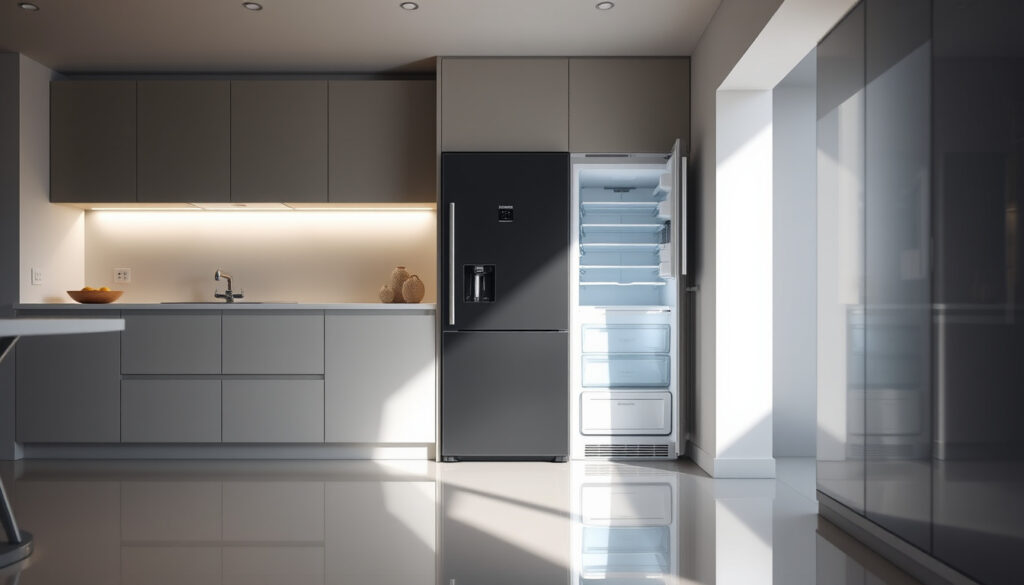
Integrated Fridge Freezer – Complete Buying Guide for UK Homes
An integrated fridge freezer is designed to sit flush behind a kitchen cabinet door, creating a seamless, built-in look that many UK homeowners prefer. Unlike freestanding models, these units are built to fit into a standard cabinet cavity, which means the dimensions, ventilation, and door alignment all need careful consideration before purchase.
The key factors that influence the choice are the cabinet size, the fridge-to-freezer split, the usable capacity, the ventilation requirements, and the features that matter most for daily use. Because integrated models are less flexible than freestanding ones, getting the specification right from the start is essential.
What Size Integrated Fridge Freezer Do I Need? (50/50, 60/40, 70/30)
50/50, 60/40, 70/30 – choose based on frozen vs chilled storage needs. Typical heights: 177cm, 182cm.
No manual defrost needed. Look for ‘No Frost’ or ‘Frost Free’ technology. Saves time and keeps food fresh.
Bosch, AEG, Beko, Hotpoint, Fridgemaster. Consider reliability, warranty, and after-sales support.
£300–£1000+ for standard models. Energy rating (A–G) affects running costs. Features like sliding hinge add value.
- Integrated fridge freezers are designed to fit flush with kitchen cabinetry, offering a seamless look.
- The most common sizes in the UK are 50/50 and 60/40 splits, but 70/30 is gaining popularity for larger freezer needs.
- Frost free models eliminate the need for manual defrosting, but may cost slightly more upfront.
- Energy efficiency is a key long-term cost factor – look for a rating of C or better (new 2021 EU scale).
- Installation requires proper ventilation and precise cut-out dimensions – always check the manufacturer’s specification.
- Top brands like Bosch, AEG, and Miele offer higher reliability, while Beko and Hotpoint provide good value for money.
| Fact | Value |
|---|---|
| Typical Height | 177–182 cm (adjustable feet vary) |
| Typical Width | 55–60 cm (most are 54.6 cm wide) |
| Typical Depth | 54–55 cm (excluding door) |
| Most Common Split | 50/50 (balanced) and 60/40 (more fridge space) |
| Frost Free Availability | Yes, many models offer No Frost or Frost Free technology |
| Energy Rating Scale (2021) | A to G (A is best, G is worst) |
| Average Noise Level | 35–42 dB (quiet models around 35 dB) |
| Typical Price Range | £300–£1,500 (mid-range £400–£700) |
| Common Brands | Bosch, AEG, Beko, Hotpoint, Samsung, Fridgemaster |
| Warranty | 2–5 years, depending on brand and retailer |
What Are the Best Integrated Fridge Freezer Brands?
Premium brands: Bosch, AEG, and Miele
Bosch and AEG are frequently recommended for their build quality, reliable cooling performance, and comprehensive warranties. Which? includes Bosch and AEG among the brands that consistently score well in independent tests. Miele sits at the top end of the market, with longer warranties and higher price points, but also with a reputation for longevity.
Mid-range and value brands: Beko, Hotpoint, and Fridgemaster
Beko, Hotpoint, and Fridgemaster are among the brands that Which? lists as budget-friendly options, often available for around £500 and under. These models typically offer good value for money, though they may have fewer features and slightly higher energy consumption than premium alternatives. The best value often depends on your cabinet constraints rather than brand alone, as noted by Marks Electrical.
Hughes gives a broad UK pricing range: £300–£500 for budget models, £500–£1,000 for mid-range, and £1,500+ for premium or larger designs. Start by measuring your cabinet cavity, then look for the best-rated model within that size bracket.
Where to buy: AO, Currys, Argos, and Appliances Direct
Major UK retailers such as AO, Currys, Argos, and Appliances Direct all stock integrated fridge freezers. Their category pages often include filters for split ratio, brand, and price, but they rarely provide detailed buying advice. Independent comparison sites like Which? and Good Housekeeping offer more thorough testing data.
How to Choose an Integrated Fridge Freezer: Frost Free vs. Standard
What is frost free technology?
Frost free, also referred to as No Frost, is a technology that prevents ice buildup inside the freezer compartment by automatically cycling warm air through the unit. This eliminates the need for manual defrosting. Most integrated models now offer this feature, though it may add a small premium to the upfront cost.
Energy efficiency and running costs
Energy efficiency is a key long-term consideration because integrated models can be more expensive and capacity-limited, so running costs matter. The new 2021 EU energy label uses an A to G scale, with A being the most efficient. The Energy Saving Trust notes that a fridge freezer with a good energy rating can save around £40–£70 a year compared to an inefficient model.
In 2021, the EU introduced a new energy label scale (A–G) that is more stringent than the old one. An A-rated model today is very efficient, but actual energy consumption still depends on usage and ambient temperature. Always compare models using the same label scale.
Noise levels and smart features
Noise level is worth checking, especially if the kitchen is open-plan. Typical integrated models operate between 35 and 42 dB, with quieter ones around 35 dB. Smart controls and temperature precision features are more common on higher-end models, offering Wi-Fi connectivity and app-based monitoring.
How to Install an Integrated Fridge Freezer
Measuring the cabinet cavity
Before buying, measure the cabinet cavity height, width, and depth carefully. Most UK integrated models are built around a 60cm-wide cabinet, with typical heights around 177–178cm and depths around 55cm. Siemens notes that built-in versions can range from roughly 54cm to 60cm wide and 71cm to 177cm high for certain categories. Always check the appliance’s stated dimensions against your own cavity.
Ventilation requirements
Ventilation is essential to avoid overheating. One guide advises at least 2cm of clearance around the top and sides, while another recommends more generous clearance depending on the layout. Some models include a ventilation grille at the bottom. Always follow the manufacturer’s instructions for airflow gaps.
Professional installation may be needed for a proper fit, especially for integrated units where cabinet integration and ventilation matter. Check your warranty terms – some manufacturers require certified installation to keep the warranty valid.
Door alignment and sliding hinges
The fridge freezer’s split and hinge setup should match your cabinet doors so the fronts line up properly. A sliding door hinge allows the appliance door to slide along the cabinet door, eliminating the need for a gap to open. This is a key feature for integrated models and should be verified before purchase.
Where to Buy Integrated Fridge Freezers in the UK
Online retailers and high street stores
AO, Currys, Argos, Appliances Direct, and Marks Electrical all carry integrated fridge freezers. Their category pages offer filters for split ratio, brand, and price, but are generally shallow on educational content. For detailed buying advice, independent sources like Which? provide expert testing and reviews.
Price ranges and what to expect
Hughes gives a broad UK pricing range: £300–£500 for budget models, £500–£1,000 for mid-range, and £1,500+ for premium or larger designs. Which? notes that budget brands like Beko, Candy, Fridgemaster, Hisense, Hoover, Hotpoint, Ikea, Indesit, Kenwood, and Logik are often available for around £500 and under.
Cost of ownership over time
The initial purchase price is only part of the equation. A more efficient model (rated B or A) can save over £100 in electricity bills across a decade compared to a lower-rated one. The Energy Saving Trust provides guidance on running costs and energy efficiency.
How Have Integrated Fridge Freezers Developed Over Time?
- 1950s – First built-in refrigerators appear in luxury kitchens.
- 1980s – Integrated fridge freezers become popular in UK fitted kitchens.
- 2000s – Frost-free technology becomes mainstream.
- 2010s – Energy efficiency regulations tighten, pushing for A+ and A++ ratings.
- 2021 – New EU energy label scale (A–G) introduced, replacing A+++ to D.
- 2025 – Current market includes smart features, Wi-Fi connectivity, and improved insulation materials.
What Should You Know About Frost Free Technology and Installation?
Some aspects of integrated fridge freezers are well established, while others remain less certain. The table below clarifies common points of confusion.
| Established information | Information that remains unclear |
|---|---|
| Frost free and No Frost are typically the same technology – they prevent ice buildup via automatic defrost cycles. | Some models may use different terms (e.g., ‘Frost Free’ vs ‘No Frost’) but function identically. |
| Many integrated fridge freezers are designed for DIY installation, but professional fitting is recommended for proper ventilation and door alignment. | Warranty terms vary – some manufacturers require certified installation, while others do not. |
| Energy labels follow the 2021 EU scale (A–G), which is more stringent than the old system. | Actual energy consumption varies depending on usage patterns and ambient temperature. |
| Manufacturer noise levels are measured in lab conditions. | Real-world noise may differ due to installation, flooring, and nearby objects. |
How Do Integrated Fridge Freezers Fit Into the Modern Kitchen?
Integrated models offer a built-in look that many homeowners prefer for fitted kitchens, but they typically have less capacity than freestanding ones. Which? notes that the biggest integrated models it tested held about ten shopping bags, which is a useful benchmark for capacity planning.
Market trends show increasing demand for large capacity freezers, particularly 70/30 splits, driven by bulk buying habits. Smart features such as Wi-Fi connectivity and temperature alerts are becoming more common on higher-end models. The cost of ownership over 10 years includes both the initial price and the energy cost, with more efficient models saving significant amounts.
Environmental impact is also a consideration. Energy efficiency and refrigerant type (R600a is common and has low global warming potential) are important factors. Disposal of old units should be handled through local recycling schemes.
What Do the Experts Say About Integrated Fridge Freezers?
“Integrated fridge freezers are a great choice for a seamless kitchen look, but check the cut-out size carefully before buying.”
Which? UK
“A fridge freezer with a good energy rating can save you around £40–£70 a year compared to an inefficient model.”
Energy Saving Trust
For official product specifications and installation guides, manufacturers such as Bosch and AEG provide detailed information. The EU Energy Label site explains the official energy rating scale.
What Is the Best Way to Choose an Integrated Fridge Freezer?
Start by measuring your cabinet cavity, then decide on the split ratio that matches your household’s fresh versus frozen food storage habits. Compare capacity, energy efficiency, and features such as frost free technology and noise level. For a broader overview of refrigeration options, see our Complete Fridge Freezer Buying Guide or explore Best Freestanding Fridge Freezers 2025 for comparison with freestanding models.
Frequently Asked Questions
How long do integrated fridge freezers last?
Average lifespan is 10–15 years, depending on brand, usage, and maintenance. Regular cleaning and proper ventilation can extend life.
Can I replace my integrated fridge freezer with a different size?
Yes, but you must ensure the new unit fits the existing cut-out dimensions (height, width, depth). Many manufacturers offer different capacities within the same housing size.
Do integrated fridge freezers need ventilation?
Yes, most require gaps at the back or top for airflow. Some models have a ventilation grille at the bottom. Check the installation manual for specific requirements.
What is the best integrated fridge freezer for a small kitchen?
A 50/50 split with a height of 177 cm and width of 55 cm is common. Compact models from brands like Beko or Fridgemaster are popular.
Are integrated fridge freezers more expensive than freestanding?
Generally, yes – integrated models cost more due to the custom panel support and sliding hinge mechanism. However, prices vary by brand and features.
What is a sliding door hinge?
A sliding door hinge allows the fridge door to slide along the cabinet door, eliminating the need for a gap to open. It’s a key feature for integrated models.
What is the difference between 50/50 and 60/40?
A 50/50 split gives equal fridge and freezer space. A 60/40 split gives more fridge space (60%) and less freezer space (40%).
What energy rating should I look for?
Look for a rating of C or better on the new 2021 EU scale (A–G). A more efficient model can save £40–£70 per year in running costs.
Do I need professional installation?
Professional installation is recommended for proper ventilation and door alignment. Some warranties require certified installation to remain valid.
What is a typical noise level for an integrated fridge freezer?
Typical models operate between 35 and 42 dB. Quieter models are around 35 dB, which is suitable for open-plan kitchens.
More related posts
 How Old I David Attenborough – 100th Birthday, Family and Life
 DWP Home Ownership Pensioners – Pension Credit Rules Explained
 Aston Villa vs Young Boys – 2-1 Win Report and Stats
 New Look Discount Code – Verified Student, NHS & First Order Deals
 Pokemon Go Redeem Code – Active Codes and Redemption Guide
 M&S Login – How to Sign Into Your Account, Sparks, Bank & Employee Portal
 M&S Trousers – Complete Guide to Women’s & Men’s Styles
 Need a Loan Been Refused Everywhere UK Direct Lender – Bad Credit Guide