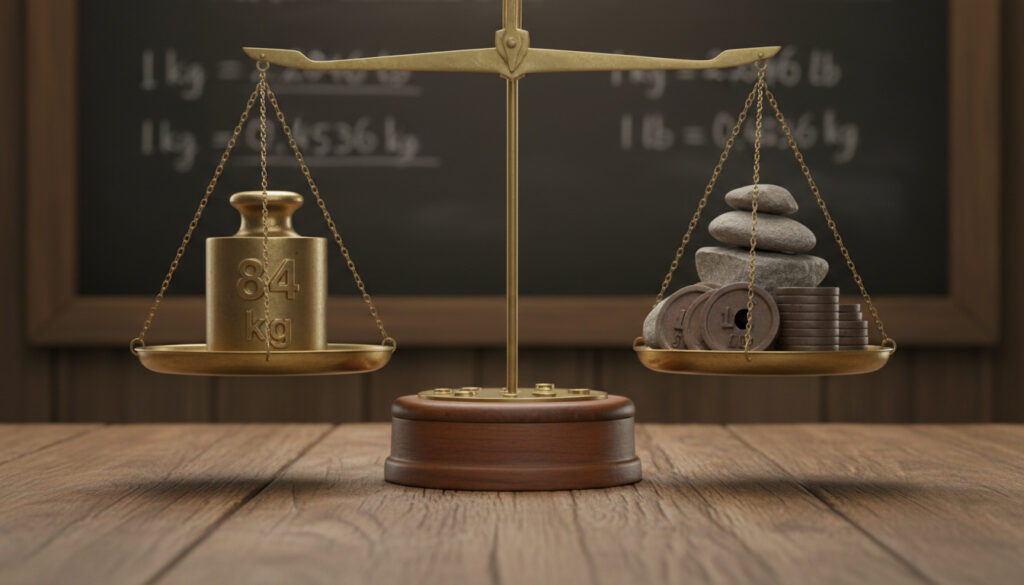
84 kg in Stone – Exact Conversion and Pounds Guide
Eighty-four kilograms converts to exactly 13 stone and 3.2 pounds, or approximately 13.23 stone. This measurement remains standard for body weight in the United Kingdom, despite metric adoption elsewhere in daily life.
The conversion relies on precise international definitions established in 1959. One stone equals exactly 14 pounds, and one pound equals exactly 0.45359237 kilograms. These fixed ratios allow exact mathematical conversion between metric and imperial systems.
While most European Union nations use kilograms exclusively for body weight, British medical records, fitness tracking, and casual conversation frequently alternate between metric and stone measurements. Understanding both systems proves essential for interpreting health data, travel, and international sports statistics.
How Many Stone is 84 kg?
- The International Yard and Pound Agreement of 1959 fixed the pound at exactly 0.45359237 kg, making the stone exactly 6.35029318 kg.
- Eighty-four kilograms yields 13 full stone with a remainder of approximately 3.19 pounds.
- Medical professionals in the UK often record patient weight in kilograms, while patients commonly self-report in stone.
- The calculation uses simple division: 84 ÷ 6.35029318 = 13.2277357311 stone.
- Gym equipment and nutritional supplements, such as Gold Standard Whey Protein – 2025 Review and Nutrition Guide, typically display weights in kilograms regardless of regional preference.
- Decimal stone measurements (13.23) appear in data tracking, while whole stone and pound fractions (13 st 3 lb) dominate spoken English.
- Avoirdupois pounds—the standard for body weight—differ from troy pounds used in precious metals, though the stone unit applies only to avoirdupois.
| Unit | Value | Notes |
|---|---|---|
| Kilograms | 84 | Base SI unit of mass |
| Stone (decimal) | 13.2277 | Exact to 4 decimal places |
| Stone and Pounds | 13 st 3.2 lb | Common UK expression |
| Pounds (total) | 185.19 | 14 lb per stone |
| Grams | 84,000 | Metric subdivision |
| Ounces | 2,963 oz | 16 oz per pound |
What is 84 kg in Stone and Pounds?
Breaking down 84 kilograms into stone and pounds yields 13 stone and 3.2 pounds. The 0.2 pounds represents approximately 3.2 ounces, though most casual scales round to the nearest pound, displaying 13 stone 3 lb.
The stone unit divides cleanly into 14-pound segments. When converting 84 kg, the calculation first determines total pounds—185.188 pounds—then divides by 14 to extract full stone units. Thirteen stone equals 182 pounds, leaving the 3.2-pound remainder.
While everyday conversation rounds to 13 stone 3 lb, the exact mathematical conversion of 84 kg yields 13.2277357311 stone. This level of precision proves necessary only in scientific or medical dosing contexts.
British bathroom scales typically offer dual displays, showing both kilograms and stone/pounds simultaneously. This dual system reflects the UK’s transitional position between metric and imperial standards, formalized legally but flexibly applied in domestic settings.
How to Convert KG to Stone
Step-by-Step Formula
Converting kilograms to stone requires dividing the kilogram value by 6.35029318. For 84 kg, this means 84 ÷ 6.35029318 = 13.2277357311 stone. To express this in stone and pounds, multiply the decimal portion (0.2277357311) by 14, yielding approximately 3.19 pounds.
Reverse conversion—from stone to kilograms—requires multiplying the stone value by 6.35029318. Thus, 13 stone equals 82.5538113 kg; adding the 3.2-pound remainder (1.450 kg) brings the total to approximately 84 kg.
Online conversion tools may display slightly different decimal values depending on rounding protocols. CalculateMe and conversion calculators both provide precise results, though final displays may truncate at two decimal places.
Quick Reference Table
| Kilograms | Stone (decimal) | Stone and Pounds | Pounds |
|---|---|---|---|
| 80 | 12.60 | 12 st 8.4 lb | 176.4 |
| 81 | 12.76 | 12 st 10.6 lb | 178.6 |
| 82 | 12.91 | 12 st 12.8 lb | 180.8 |
| 83 | 13.07 | 13 st 1.0 lb | 183.0 |
| 84 | 13.23 | 13 st 3.2 lb | 185.2 |
| 85 | 13.39 | 13 st 5.4 lb | 187.4 |
| 86 | 13.54 | 13 st 7.6 lb | 189.6 |
| 87 | 13.70 | 13 st 9.8 lb | 191.8 |
| 88 | 13.86 | 13 st 12.0 lb | 194.0 |
| 89 | 14.02 | 14 st 0.2 lb | 196.2 |
| 90 | 14.17 | 14 st 2.4 lb | 198.4 |
Data sourced from The Calculator Site and conversion tables maintained by engineering references.
Related Conversions: 80 kg, 85 kg, and 90 kg in Stone
Comparison Chart
Eighty kilograms converts to 12 stone 8.4 pounds—roughly half a stone lighter than 84 kg. Eighty-five kilograms equals 13 stone 5.4 pounds, while 90 kg translates to 14 stone 2.4 pounds. These benchmarks help contextualize weight ranges for fitness goals and medical assessments.
The jump from 84 kg to 90 kg represents nearly one full stone increment (0.94 stone). For athletes monitoring weight classes—common in boxing, martial arts, and rowing—these distinctions determine competition eligibility. A fighter weighing 84 kg falls into the light heavyweight category in many amateur systems, while 90 kg shifts classification.
Whether 84 kg constitutes a healthy weight depends entirely on height and body composition. For an average UK male (1.76 m), 84 kg produces a BMI of approximately 27.1, falling within the overweight range (25-29.9). For an average UK female (1.62 m), the same weight yields a BMI of roughly 32.0, classified as obese (≥30).
Nutritional planning for individuals at 84 kg varies by activity level. Sedentary adults require fewer calories than those engaged in heavy resistance training. Gold Standard Whey Protein – 2025 Lab-Tested Review Guide offers protein supplementation data relevant to individuals managing weight within this range.
The History of Stone Measurement
- Medieval Period (circa 14th century): Local merchants in England use variable “stone” units for trading wool and grain, with values differing by commodity and region.
- 1389: Royal statute standardizes the stone to 8 London bushels of wheat, approximately 5 kilograms by modern estimation.
- 1824: The Weights and Measures Act legally defines one stone as exactly 14 pounds avoirdupois, creating the modern standard still used today.
- 1959: International agreement fixes the pound at exactly 0.45359237 kilograms, indirectly fixing the stone at 6.35029318 kg.
- 1965: UK government adopts metrication for industry and education, though stone measurements remain exempt for body weight in informal contexts.
- Present Day: Stone units persist exclusively in UK and Irish common parlance for human body weight, disappearing from trade and scientific use.
What We Know for Certain About 84 kg Conversions
Established Facts
- 84 kg equals exactly 13.2277357311 stone mathematically
- 1 stone = 14 pounds = 6.35029318 kg by international treaty
- The conversion formula (kg ÷ 6.35029318) yields consistent results globally
- UK medical professionals train in kilograms but communicate in stone with patients
Variables and Context
- Health implications of 84 kg depend on height, age, sex, and muscle mass
- Cultural usage of stone varies by UK region and generation
- Digital scales may round 13.227 stone to 13.2 or 13.23 depending on settings
- Legal requirements for trade prohibit stone units; metric is mandatory for commercial sales
Why the Stone Unit Persists in Modern Britain
Despite mandatory metric education in UK schools since the 1970s, stone measurements survive through social transmission. Parents record newborn weights in pounds and ounces, then shift to stone as children age. This creates generational continuity that metric-only systems lack in countries like Germany or France.
The stone offers psychological segmentation. Fourteen-pound increments feel substantial enough to mark progress in weight loss without the granularity of single pounds or the abstraction of kilograms. A shift from 14 stone to 13 stone signals achievement more clearly than 88.9 kg to 87.5 kg for many British dieters.
However, the National Health Service (NHS) records all patient data in kilograms to ensure international compatibility and precise medication dosing. This dual-track system—clinical metric and domestic imperial—creates no practical confusion among users who comfortably switch between contexts.
Official Definitions and Standards
The pound (avoirdupois) is legally defined as exactly 0.45359237 kilograms. Consequently, the stone, being 14 pounds, equals exactly 6.35029318 kilograms. These definitions originate from the 1959 international agreement among English-speaking nations to standardize weights and measures for trade.
—Derived from physics reference standards and NIST specifications
The Weights and Measures Act 1824 established that one stone equals fourteen pounds avoirdupois. This statute replaced earlier variable definitions and remains the legal foundation for the unit’s use in the United Kingdom today.
—UK Legislative Archives
Summary of 84 kg in Stone
Eighty-four kilograms converts precisely to 13 stone and 3.2 pounds, or 13.23 stone in decimal terms. This conversion relies on the fixed international definition of the pound (0.45359237 kg) and the stone (14 pounds). While the metric system dominates scientific and medical applications globally, the stone remains culturally significant in the UK for body weight reference. For those tracking fitness progress or nutritional intake, understanding both systems allows seamless navigation of international health data and Gold Standard Whey Protein – 2025 Review and Nutrition Guide specifications.
Frequently Asked Questions
What is 1 stone in kg?
One stone equals exactly 6.35029318 kilograms, derived from 14 pounds at 0.45359237 kg per pound.
Is 84 kg overweight?
It depends on height. For a 1.76 m male, 84 kg gives a BMI of 27.1 (overweight). For a 1.62 m female, BMI is 32.0 (obese). Muscle mass also affects health classification.
How much is 90 kg in stone?
Ninety kilograms converts to 14 stone and 2.4 pounds, or approximately 14.17 stone.
Why does the UK still use stone?
Cultural continuity and intuitive segmentation. Stone measurements persist in casual body weight discussion despite metric adoption for trade and education in 1965.
How many pounds in 84 kg?
Eighty-four kilograms equals approximately 185.19 pounds avoirdupois.
What’s the difference between stone and kilograms?
Kilograms are metric base units; stone are imperial units equal to 14 pounds. Stone see use primarily in UK/Ireland for body weight, while kilograms are universal scientific standards.
More related posts
 Caretta Beach Resort & Waterpark – Complete 2025 Guide
 Capital Gains Tax Calculator – Free Tool for Shares, Property & Crypto
 Cast of the Bill – Complete Guide to Actors and Characters
 When Do Pregnancy Symptom Start? – A Clear Timeline of Early Sign
 Joe Alfie Winslet Mendes – Kate Winslet and Sam Mendes Son
 Eubank v Benn 2 – Conor Benn Wins Unanimous Decision Full Breakdown
 Sheila Fearn – Actress Biography and What We Know in 2025
 Elle Smith – Miss USA 2021, Journalist, and Fact Check