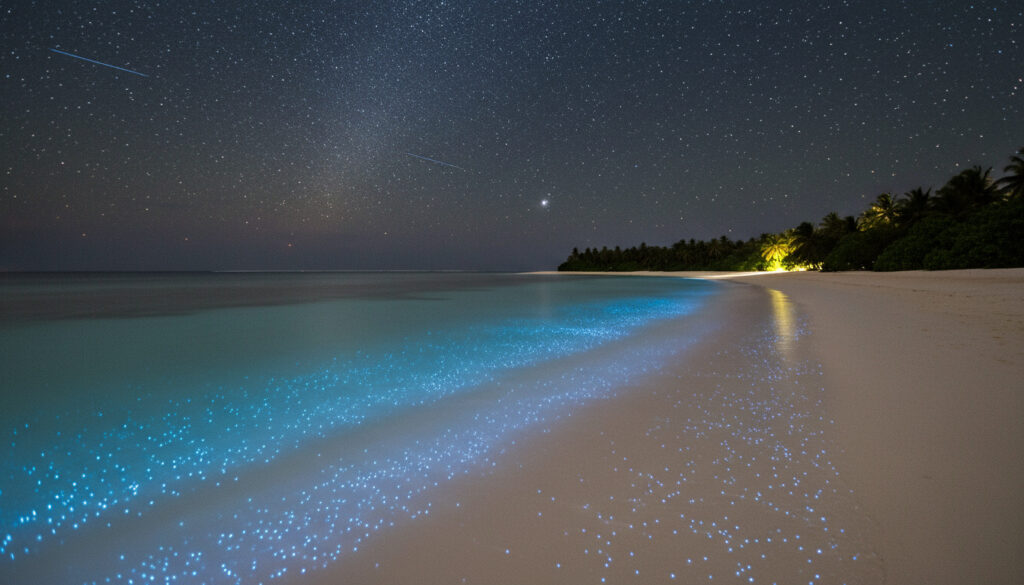
Sea of Stars Maldives – Where, When and How to Visit Vaadhoo
Vaadhoo Island in Raa Atoll hosts one of the world’s most accessible bioluminescent displays, locally known as “Redhan lun.” The phenomenon occurs when microscopic marine organisms transform the island’s shoreline into an electric blue canvas visible to the naked eye.
Unlike remote bioluminescent sites requiring boat access or specialized tours, this natural light show unfolds directly on the beach. Visitors witness waves breaking into neon fragments and footsteps igniting star-like sparks in the wet sand without purchasing tickets or boarding vessels.
The display has positioned the Maldives as a premier destination for nocturnal coastal phenomena, drawing photographers and naturalists seeking the intersection of marine biology and atmospheric conditions. The intensity of the experience depends on understanding the specific conditions that trigger the brightest emissions.
What Is the Sea of Stars Maldives and Where Does It Occur?
Vaadhoo Island, Raa Atoll, Maldives
Bioluminescent plankton (dinoflagellates)
New moon nights, November–April
Speedboat from Malé or Ifuru Airport
- The natural light show originates from marine plankton agitated by wave action and movement
- Visibility depends entirely on specific environmental conditions including lunar cycles
- Local tourism emphasizes low-impact, eco-friendly viewing practices
- The phenomenon has become a focal point for night photography enthusiasts
- Residents have known the display as “Redhan lun” for generations before global fame
- Vaadhoo ranks among only five global sites offering accessible shore-based bioluminescence
- Beach access remains free without mandatory tour fees or boat charters
| Attribute | Details |
|---|---|
| Local Name | Redhan lun (Dhivehi) |
| Primary Species | Noctiluca scintillans |
| Island Population | Approximately 500 residents |
| Geography | Circular island with protected lagoon |
| Accessibility | Shore-based, no boat required |
| Viewing Cost | Free |
| Peak Season | December to April |
| Alternative ID | Lingulodinium polyedrum (conflicting) |
| Optimal Conditions | New moon, 1-3 hours post-sunset |
| Transport Cost | 45-65 USD speedboat from Malé |
What Causes the Bioluminescent Glow in the Maldives?
The Chemistry of Light
The emission results from dinoflagellates releasing luciferin, a light-emitting compound. When oxygen interacts with this chemical, the reaction produces the characteristic neon blue glow visible when waves crash or footsteps disturb the water. Scientific monitoring confirms this biochemical process occurs when physical agitation triggers the defensive light response in microorganisms.
Vaadhoo’s Unique Geography
The island’s circular formation creates a protected lagoon with gradual depth transitions. These nutrient-rich waters concentrate plankton populations, while the “round island” geography—reflected in its Dhivehi name—provides natural protection from harsh currents. Geographic surveys indicate this topology creates ideal conditions for sustained plankton colonies.
While Noctiluca scintillans dominates local scientific descriptions, taxonomic records indicate some sources cite Lingulodinium polyedrum instead. This identification conflict does not affect the visual phenomenon, but marine biologists continue monitoring which organism predominates during different seasonal blooms.
Environmental Variables
Water temperature, salinity levels, tidal movements, and nutrient availability determine nightly intensity. The phenomenon is not chemically limited to Vaadhoo; similar dinoflagellates appear across Maldives atolls, resorts, and even near the capital Malé, though consistency varies by location.
When Is the Best Time to Witness the Sea of Stars?
Seasonal Patterns
The bioluminescence occurs throughout the year, though intensity peaks during the dry season from December through April. Calmer seas during these months reduce sediment disturbance, allowing higher plankton concentrations to remain near the surface.
Arrive at the beach 1-3 hours after sunset during new moon phases. This timing balances complete darkness with peak plankton activity levels.
Lunar Cycles and Darkness
New moon phases provide optimal viewing conditions. The window following sunset offers sufficient darkness while the organisms remain active. Full moons introduce light pollution that obscures the subtle blue glow, making timing crucial for first-time visitors.
Weather Considerations
Late summer and early fall occasionally produce notable displays, though environmental factors become less predictable outside the dry season. Warm, calm nights generally enhance the intensity of the reaction.
How Do Visitors Reach Vaadhoo Island and What Should They Expect?
Transportation Logistics
Travelers arrive via speedboat from Malé International Airport, typically costing between 45 and 65 USD for the approximately 20-minute journey. Alternatively, Ifuru Airport serves as a closer domestic hub for Raa Atoll, reducing water transfer times significantly. Transportation guides confirm speedboat services operate regularly from the capital.
Buy-to-Let Mortgages – 2026 Rates and Best Deals
On-Site Experience
Unlike commercialized bioluminescent sites requiring kayak tours or boat excursions, Vaadhoo’s beaches allow direct access. Visitors simply walk to the shoreline after dark. The village maintains a permanent population of roughly 500 residents, functioning as a working fishing community rather than a resort island.
Increased tourism traffic raises concerns regarding light pollution and ecosystem disruption. Tourism officials emphasize that shore access keeps environmental impact lower than motorized tour alternatives, but visitors should minimize flashlight use and avoid chemical contamination of the water.
Complementary Activities
While no formal tours are required for the beach glow, night diving excursions reveal underwater bioluminescence, fluorescent corals, and nocturnal marine life including manta rays. Raa Atoll contains over 25 dive sites within 20 minutes of the island, available at local pricing structures.
How Did the Sea of Stars Gain International Recognition?
- Pre-2010s: Local fishing communities documented “Redhan lun” as a familiar seasonal occurrence, integrating the phenomenon into cultural knowledge without external scientific classification.
- 2010s: Social media documentation transformed the local curiosity into a global viral destination, attracting international travel media and photography enthusiasts.
- Present: Scientific monitoring continues year-round, with the Maldives Tourism Board officially promoting the phenomenon as a “sense of awe” experience while emphasizing its natural variability.
What Facts Are Established About the Sea of Stars?
| Established Information | Uncertain or Variable Factors |
|---|---|
| The phenomenon results from scientifically verified bioluminescence in dinoflagellate populations | Nightly visibility cannot be guaranteed due to fluctuating plankton bloom cycles |
| Noctiluca scintillans is the primary identified species at Vaadhoo | Taxonomic classification conflicts with Lingulodinium polyedrum in some literature |
| Vaadhoo Island provides year-round shore access without admission fees | Specific nutrient triggers and water temperature thresholds for peak glow remain under study |
| The glow occurs when physical disturbance agitates the microorganisms | Climate change impacts on long-term plankton sustainability require continued monitoring |
How Does Vaadhoo Compare to Global Bioluminescent Sites?
Vaadhoo distinguishes itself from competitors like Puerto Rico’s Mosquito Bay or Japan’s Toyama Bay through accessibility and cost structure. While Mosquito Bay requires guided kayak tours through mangrove channels and Toyama Bay demands boat access for firefly squid viewing, Vaadhoo offers immediate beach access without reservation systems or equipment rental. Marine biology research classifies this shore-based accessibility as rare among global bioluminescent destinations.
The Maldives Tourism Board positions the experience within a broader strategy of “right-place-right-time” tourism, acknowledging that bioluminescence appears intermittently across the archipelago. This approach contrasts with fixed-site attractions, distributing visitor impact while maintaining ecological safeguards. The shore-based model generates lower carbon footprints compared to motorized tour boats required at other global sites.
What Do Official Sources Say About the Phenomenon?
The Sea of Stars represents a sense of awe that defines Maldivian natural heritage, emphasizing right-place-right-time viewing without fixed sites.
Maldives Tourism Board via Visit Maldives
Researchers monitor Vaadhoo’s plankton populations specifically for climate change effects, using temperature and nutrient data to track ecosystem health.
Local Scientific Monitoring Teams
Killers of the Flower Moon – True Story of Osage Murders
Is the Sea of Stars Maldives Worth Visiting?
The Sea of Stars offers a rare combination of scientific wonder, accessibility, and cultural authenticity unmatched by most global bioluminescent sites. Visitors seeking guaranteed nightly entertainment may face disappointment due to natural variability, but those prepared for patient observation during optimal lunar and seasonal windows will encounter one of the few freely accessible marine light shows on Earth. The experience requires minimal financial investment beyond transportation, supports local fishing communities, and operates within a framework of ongoing ecological monitoring. For travelers prioritizing natural phenomena over manufactured attractions, Vaadhoo Island delivers a distinctly Maldivian experience where the ocean itself becomes the light source.
Frequently Asked Questions
Can visitors swim in the bioluminescent water?
Yes, swimming is possible and movement through the water triggers additional glow reactions. However, visitors should avoid wearing sunscreen or lotions that might harm the plankton populations.
Does the glow appear every night?
No, visibility depends on plankton concentration, weather conditions, and lunar cycles. The phenomenon occurs year-round but intensity varies significantly.
Are guided tours necessary to view the Sea of Stars?
No formal tours are required. Visitors can walk directly to Vaadhoo’s beaches independently. Night diving tours are available separately for underwater viewing.
What photography equipment is recommended?
Long exposure settings (10-30 seconds) on tripods capture the glow effectively. Flash photography should be avoided as it washes out the subtle bioluminescence.
Are there other islands in the Maldives with similar phenomena?
Yes, bioluminescence appears across Maldives atolls including resort islands and areas near Malé, though Vaadhoo offers the most consistent shore-based accessibility.
How long does each glow last when disturbed?
The chemical reaction produces light for fractions of a second per disturbance. Continuous movement creates trailing light effects visible to the eye.
Is Vaadhoo Island inhabited?
Yes, approximately 500 residents live in the fishing village. The community maintains traditional livelihoods alongside tourism exposure.
More related posts
 Chinese Yen to GBP – Live Rate and Conversion Guide
 Eve Pollard – Journalist, Author and Claudia Winkleman’s Mother
 NS&I British Savings Bonds Relaunch – Latest Rates and Key Details
 Jo Blythe – Biography, Age, Net Worth and Social Media
 Tax Free Childcare Calculator – Check Your Top-Up & Eligibility
 Gary Delaney – The Puns Master and Comedian Guide
 Ha The Pope Died – Pope Franci Die at 88 on Ea ter Monday
 Corn Exchange King’s Lynn – Seating Plan, Events and Panto Guide