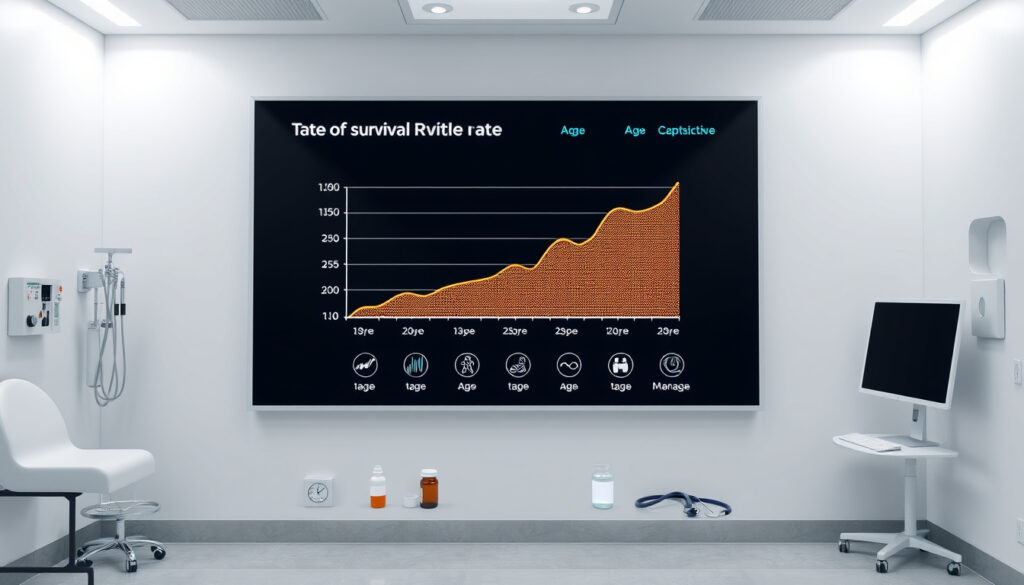
Bowel Cancer Survival Rate – Guide by Stage Age and Treatment
Bowel cancer survival depends heavily on the stage at diagnosis, the patient’s age, and whether treatment is given. In the UK, five-year survival ranges from around 90% for stage 1 disease to approximately 10% for stage 4. Younger patients tend to have better outcomes, and survival without treatment is often measured in months rather than years.
Understanding these numbers is not straightforward. Survival statistics are based on large groups of people and cannot predict an individual’s future. Factors such as overall health, tumour biology, and response to therapy all play a role. The figures below are drawn from the most authoritative UK and international sources available and reflect the most recent data as of 2025.
Bowel cancer remains a major cause of death in the UK, with more than 16,800 deaths each year according to Bowel Cancer UK. However, survival has more than doubled over the last four decades, driven by screening, earlier diagnosis, and better treatments.
Bowel Cancer Survival Rates by Age
Age at diagnosis is one of the strongest predictors of bowel cancer survival. Younger patients generally have better outcomes, but the pattern holds across all stages of disease.
| Category | Survival Rate | Source |
|---|---|---|
| Early Stage (Stage 1 & 2) | > 90% five-year survival | Cancer Research UK / Cleveland Clinic |
| Regional Spread (Stage 3) | ~ 70% five-year survival | Cancer Research UK / NHS England |
| Distant Spread (Stage 4) | ~ 15% five-year survival | Cancer Research UK / Cleveland Clinic |
| Early Diagnosis Impact | Nearly everyone survives if diagnosed at earliest stage | Bowel Cancer UK |
- Early diagnosis dramatically improves survival: from >90% at stage 1 to ~15% at stage 4.
- Survival rates vary significantly by age, with younger patients generally having better outcomes.
- Without any treatment, survival is extremely limited; median survival for elderly without surgery was 1.6 years in one study.
- UK survival rates are comparable to other high-income countries, with 1-year net survival around 78% for all stages combined.
- Advances in screening and treatment have steadily improved bowel cancer survival over the past few decades.
| Metric | Value | Source |
|---|---|---|
| Overall 5-year survival (all stages) | ~ 60-65% (UK/USA) | cancerresearchuk.org, my.clevelandclinic.org |
| Stage 1 5-year survival | ~ 95% | cancerresearchuk.org |
| Stage 2 5-year survival | ~ 85% | cancerresearchuk.org |
| Stage 3 5-year survival | ~ 65-70% | cancerresearchuk.org |
| Stage 4 5-year survival | ~ 15% (range 10-20%) | cancerresearchuk.org, my.clevelandclinic.org |
| 1-year net survival (all stages, England) | 78.5% | digital.nhs.uk (2016-2020) |
| Median survival without curative surgery (elderly) | 586 days (~1.6 years) | publishing.rcseng.ac.uk |
In the UK, data from Dr Jamie Murphy summarises the pattern: survival is highest at 69% for those aged 15–39, and drops to 46% for patients aged 80–89. These figures are not stage-specific but reflect the general trend. Cancer Research UK adds that 53.9% of patients survive bowel cancer for 10 years or more overall, with younger adults faring better.
From the Mayo Clinic (US data), age-and-stage breakdown shows that for localized colorectal cancer, under-50 patients have a 95.0% five-year survival versus 90.5% for those 50 and older. For regional disease, the gap is 79.6% versus 72.3%. For distant disease, it is 22.4% versus 14.0%. These figures are not UK-specific but illustrate the consistent advantage of younger age at every stage.
What Are Bowel Cancer Survival Rates by Stage?
Stage 1 Bowel Cancer
Stage 1 bowel cancer is highly treatable. Cancer Research UK reports a five-year survival rate of around 90% in England for patients diagnosed between 2016 and 2020. Many patients are cured, especially when the cancer is detected through Sexual Health Clinic Near Me – Find Free NHS Walk-Ins & Bookings screening or early symptoms.
Stage 2 Bowel Cancer
At stage 2, the cancer has grown deeper into the bowel wall but has not typically spread to lymph nodes. The UK five-year survival rate is approximately 85%. Treatment usually aims for cure, often involving surgery and sometimes adjuvant chemotherapy depending on risk factors.
Stage 3 Bowel Cancer
Stage 3 means the cancer has spread to nearby lymph nodes. The five-year survival rate in the UK is about 65%. Survival depends on successful surgical removal, the use of chemotherapy, and the patient’s overall fitness. Age continues to play a role: younger patients at stage 3 have better outcomes than older ones.
Stage 4 Bowel Cancer
Stage 4 bowel cancer has spread to distant organs, most commonly the liver or lungs. The UK five-year survival rate is around 10%. Some patients live much longer with modern systemic treatments, but the overall prognosis remains poor. Age also matters here: under-50 patients with distant disease have a 22.4% five-year survival (US data), compared with 14.0% for those 50 and older.
The UK stage-specific figures above come from Cancer Research UK and are based on patients diagnosed in England from 2016 to 2020, followed up to 2021. They reflect real-world outcomes where most patients received some form of treatment. Survival for untreated bowel cancer is discussed separately.
What Is the Bowel Cancer Survival Rate Without Treatment?
There are no standard UK national survival tables for untreated bowel cancer broken down by stage and age. Most survival datasets include patients who receive surgery, chemotherapy, radiotherapy, or palliative care. Information on what happens without treatment is typically inferred from patients who were not suitable for curative surgery, those receiving best supportive care, or older, frailer individuals in observational studies.
Evidence from a study in elderly patients
A study published in the Annals of the Royal College of Surgeons of England examined outcomes in people over 85 with colorectal cancer. It found that those receiving best supportive care had a mean survival of 9.7 months. Patients who underwent curative surgery survived an average of 41.6 months, and those receiving other treatment survived 27.3 months. The study reported that survival was significantly poorer in the best supportive care group, and that after two years, curative surgery showed a clear survival benefit.
This single study is not a comprehensive UK-wide stage-based untreated survival table. It provides strong evidence that not treating colorectal cancer curatively can sharply reduce survival, especially in very old patients. However, the exact survival for untreated bowel cancer across different ages and stages remains poorly defined in national statistics.
In summary, while precise numbers are lacking, the available evidence suggests that without curative treatment, survival can fall to months or a few years, particularly in advanced disease.
Bowel Cancer Survival Rate in the UK
Bowel cancer is the fourth most common cancer in the UK, with about 44,000 new cases each year according to Bowel Cancer UK. Around 94% of new cases occur in people over 50, but more than 2,600 cases are diagnosed in people under 50 annually. The lifetime risk is 1 in 17 for men and 1 in 20 for women.
Survival has improved substantially over the past few decades. The main drivers are screening (the NHS Bowel Cancer Screening Programme), earlier diagnosis, better surgical techniques, and improved chemotherapy and radiotherapy. According to Cancer Research UK, overall five-year survival for all stages combined is around 60-65%, and one-year net survival in England reaches 78.5%.
The reasons include: widespread use of faecal immunochemical testing (FIT) and colonoscopy for screening; increased public awareness of symptoms; centralisation of bowel cancer surgery into specialist teams; and the introduction of targeted therapies and immunotherapies for certain tumour types.
How Has Bowel Cancer Survival Improved Over the Decades?
- 1970s: Five-year survival was around 40%. Surgery was the mainstay, and chemotherapy was limited.
- 1990s: Survival rose to approximately 50%, driven by better surgical techniques and the introduction of adjuvant chemotherapy.
- 2000s: The NHS Bowel Cancer Screening Programme began (faecal occult blood test), leading to earlier detection. Survival exceeded 60%.
- 2010s: Targeted therapies (e.g., anti-EGFR drugs) and improved staging became routine. Survival climbed above 60% and continued to rise.
- 2020s: Immunotherapy for MSI-H bowel cancers and ongoing treatment refinements have pushed five-year survival to around 65% overall.
How Reliable Are Bowel Cancer Survival Statistics?
| Established Information | What Remains Unclear |
|---|---|
| Survival rates are based on large population studies and reflect averages. | Individual prognosis can differ significantly from the average. |
| Factors such as age, overall health, tumour genetics, and treatment response strongly influence survival. | Newer treatments may achieve better survival than data from older cohorts show. |
| Five-year survival is a standard benchmark, but many people live much longer, especially with early-stage disease. | Untreated bowel cancer survival data are limited and often based on small, elderly groups. |
What Factors Influence Bowel Cancer Survival?
Stage at diagnosis is the single strongest predictor. Screening programmes aim to detect cancer at an early, more treatable stage. In the UK, the NHS FIT test is offered every two years to people aged 60 to 74 (50 to 74 in Scotland). Higher participation rates are linked to better population-level outcomes.
Age affects both the biology of the cancer and the patient’s ability to tolerate aggressive treatment. Younger patients tend to have fewer comorbidities and can often undergo more intensive therapy. The presence of other health conditions (comorbidities) also influences treatment decisions and survival.
Access to specialist care matters. Bowel cancer outcomes in the UK are comparable to other high-income countries, but regional variations exist. The overall improvement in survival since the 1970s reflects better organisation of care, not just new drugs.
What Do Major Health Organizations Say About Bowel Cancer Survival?
“Survival depends on the stage of your bowel (colorectal) cancer when you are diagnosed.”
– Cancer Research UK, Cancer Research UK – Bowel Cancer Survival
“Nearly everyone survives bowel cancer if diagnosed at the earliest stage. However this drops significantly as the disease develops.”
– Bowel Cancer UK, Bowel Cancer UK – What is Bowel Cancer?
“Localized cancer: 91% five-year survival; Regional: 73%; Distant: 13%.”
– Cleveland Clinic, Cleveland Clinic – Colon Cancer Overview
“For all stages combined, 1-year net survival (78.5%) for bowel cancer falls between survival for stages 3 and 4.”
– NHS England, NHS England – Cancer Survival by Stage
“Survival of patients without curative surgery ranged from 105 to 1,782 days with a median life expectancy of 586 days.”
– Annals of the Royal College of Surgeons of England, RCS England – Colon Cancer Survival in Elderly Without Surgery
What Is the Overall Outlook for Bowel Cancer Patients?
The outlook for bowel cancer patients has improved dramatically over the past 50 years. With early diagnosis, most patients can expect to be cured. Even for advanced disease, modern treatments are extending survival beyond what older statistics suggest. Continued improvements in screening, surgery, and systemic therapy mean that the prognosis is better today than at any time in the past. For more information on managing health conditions across the lifespan, you may also find helpful the guide on How Long Does Menopause Last – 7-Year Average, Stages Guide.
Frequently Asked Questions
What is the 10-year survival rate for bowel cancer in the UK?
Cancer Research UK reports that 53.9% of patients survive bowel cancer for 10 years or more in the UK (2018 data). Younger adults tend to have higher long-term survival.
How does the NHS screening programme affect survival rates?
Screening detects bowel cancer at an earlier stage, when it is more treatable. The NHS programme has contributed significantly to the rise in survival rates since the 2000s.
Can you survive stage 4 bowel cancer?
Yes, some patients survive stage 4 bowel cancer, especially with modern systemic treatments. The five-year survival rate is around 10%, but individual outcomes vary widely.
What is the difference between net survival and overall survival?
Net survival estimates the probability of surviving cancer after accounting for other causes of death. Overall survival counts all deaths. Net survival is often used in cancer statistics.
Why is bowel cancer survival higher in younger patients?
Younger patients generally have fewer other health conditions, better tolerance of intensive treatment, and may have different tumour biology. The pattern is consistent across all stages.
How many new bowel cancer cases are there in the UK each year?
Bowel Cancer UK reports about 44,000 new cases annually. 94% occur in people over 50, and more than 2,600 occur in people under 50.
Does bowel cancer ever go away without treatment?
Spontaneous remission is extremely rare. Without treatment, bowel cancer almost always progresses. Available evidence suggests survival without curative treatment is typically measured in months to a few years.
What is the prognosis for bowel cancer that has spread to the liver?
Spread to the liver is considered stage 4. Five-year survival is around 10%, but some patients respond well to surgery, chemotherapy, and targeted therapies, occasionally achieving long-term remission.
How has bowel cancer survival changed since the 1970s?
Survival has more than doubled, from about 40% in the 1970s to around 65% today. Improvements are due to screening, better surgery, chemotherapy, and multidisciplinary care.
More related posts
 Russell Brand – Biography, Allegations, and Christian Conversion
 Helen Keller – The Real Story Behind the Myths
 Lion’s Mane Mushroom Benefits – Cognitive and Nerve Health Insights
 Houses for Sale Swansea – 2026 Prices and Best Areas
 Fibrous Papule of the Nose – Causes Removal and Safety Guide
 Olivia Attwood Love Island – From Contestant to TV Star
 Newspaper Front Pages Tomorrow – UK US Global Previews Headlines
 M&S Login – How to Sign Into Your Account, Sparks, Bank & Employee Portal