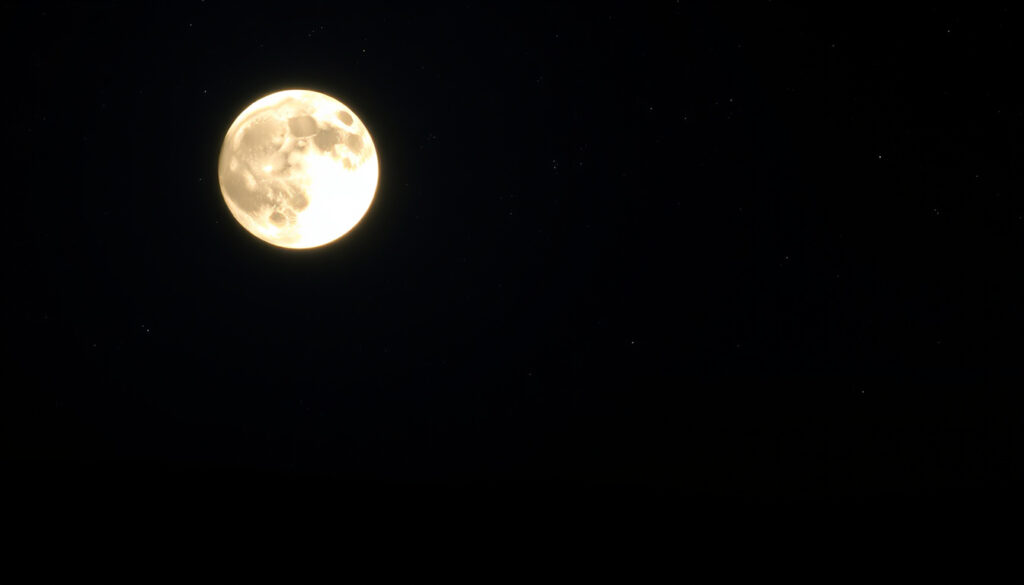
Current Phase of the Moon – Waning Gibbous Facts
The moon is currently in its Waning Gibbous phase, illuminated at approximately 55-56% and standing 21 days into its current lunar cycle. This positioning places Earth’s natural satellite in a transitional stage between the Full Moon that occurred on April 1, 2026, and the upcoming Third Quarter phase expected on April 10, 2026. Understanding where the moon stands in its monthly journey provides valuable context for skywatchers, photographers, and those interested in lunar effects on daily life.
The Waning Gibbous phase marks a period when the moon’s illuminated portion progressively decreases each night. As the lunar body moves along its orbital path, observers notice the bright surface area shrinking from the right side outward, a pattern that continues until the next New Moon arrives. This phase offers distinct viewing opportunities, particularly for those interested in observing the lunar surface’s geological features through telescopes or binoculars.
For anyone tracking celestial events or planning nighttime activities aligned with lunar visibility, knowing the current phase provides practical advantages. The moon rises between sunset and midnight during this phase, reaches its highest point in the sky during the early morning hours, and sets somewhere between sunrise and noon. This timing makes pre-dawn observation the optimal window for viewing the Waning Gibbous moon in the western sky.
What Is the Current Phase of the Moon?
As of today, the moon displays a Waning Gibbous phase characterized by roughly 55-56% illumination. The lunar body has aged 21 days since the beginning of its current cycle, placing it firmly in the second half of the monthly progression. The phase began following the Full Moon of April 1, 2026, and will continue its gradual transformation until transitioning into the Third Quarter phase on April 10, 2026, at approximately 00:55 UTC.
Unlike waxing phases where the illuminated portion grows larger night by night, the Waning Gibbous represents the moon’s gradual retreat toward darkness. The night side of the lunar surface increasingly faces Earth during this period, with sunlight falling on a diminishing portion of the moon’s face as viewed from our planet. This geometric arrangement occurs because the moon has moved past the Full Moon point in its orbit and now sits between that position and the Third Quarter marker.
Waning Gibbous
55-56%
21 days
Third Quarter — April 10
Key Facts About the Waning Gibbous Phase
- The Waning Gibbous phase follows the Full Moon and precedes the Third Quarter in the lunar cycle sequence
- During this phase, the moon’s illuminated portion decreases by approximately 12-15% each day
- The phase is visible during most of the night and early morning hours
- Long shadows cast by the sun along the lunar terminator make craters and mountains particularly prominent
- The moon rises between sunset and midnight, offering evening viewing opportunities
- Optimal observation time occurs just before sunrise when the moon sits low in the western sky
- The phase accounts for roughly one-quarter of the complete 29.53-day lunar cycle
Lunar Cycle Snapshot
| Phase Name | Illumination Range | Approximate Duration | Best Viewing Time |
|---|---|---|---|
| New Moon | 0% | 1-2 days | Not visible |
| Waxing Crescent | 1-49% | ~7 days | Evening, western sky |
| First Quarter | ~50% | ~1 day | Afternoon to evening |
| Waxing Gibbous | 51-99% | ~7 days | Evening to late night |
| Full Moon | 100% | ~1 day | Sunset to sunrise |
| Waning Gibbous | 51-99% | ~7 days | Late night to morning |
| Third Quarter | ~50% | ~1 day | Late night to early morning |
| Waning Crescent | 1-49% | ~7 days | Pre-dawn, eastern sky |
How to Determine the Moon Phase Tonight
Identifying the current lunar phase requires understanding the moon’s position relative to Earth and the Sun. During the Waning Gibbous phase, skywatchers can recognize the moon by several distinctive characteristics. The illuminated portion appears on the left side of the lunar disk when viewed from the Northern Hemisphere, while the right side remains in shadow. This orientation differs from the Waxing Gibbous phase, where the right side shows illumination and the left remains dark.
Visual Identification Methods
The Waning Gibbous moon rises after sunset and remains visible through much of the night. Observers in the Northern Hemisphere will notice the illuminated area decreasing from right to left over successive nights, a key indicator that the moon is in its waning stage. The bright portion typically occupies the left half or slightly more of the visible disk, with the shadowed region growing progressively larger each evening.
A helpful mnemonic distinguishes waning from waxing phases by considering the shape of the illuminated portion. During waning phases, the bright area resembles the letter “C” rotated 180 degrees, sometimes called a “backward C.” Waxing phases show the opposite pattern, with the illuminated portion forming a “D” shape or its mirror image. This simple visual cue provides a reliable method for determining whether the moon is growing or shrinking in its cycle.
The edge separating illuminated and dark portions of the moon during the Waning Gibbous phase creates exceptionally long shadows across lunar craters and mountain ranges. This makes the phase ideal for telescopic observation of the moon’s topography, as the pronounced shadowing reveals depth and detail not visible during the Full Moon when lighting appears flat and even.
Timing Your Observations
The Waning Gibbous moon follows a predictable schedule that helps observers plan their viewing sessions. The moon rises between sunset and midnight, reaches its highest position in the sky during the early morning hours, and sets between sunrise and noon. This timing means the moon appears prominent in the evening sky shortly after dinner, making it accessible for casual observers who prefer not to stay up late.
The optimal viewing window occurs during the pre-dawn hours, roughly 30-60 minutes before sunrise. At this time, the moon sits lower in the western sky and the sunlight illuminating its surface comes in at a shallower angle, enhancing the contrast between lit and unlit regions. Telescopes and binoculars reveal considerable detail under these conditions, including the rugged terrain along the lunar terminator where day meets night on the moon’s surface.
Dark-sky locations like the Maldives offer remarkably clear skies for lunar observation, with minimal light pollution creating excellent conditions for tracking the moon’s phase transitions. Visitors to such destinations can discern subtle variations in lunar illumination that remain invisible from urban environments.
Upcoming Moon Phases and Full Moon Dates
The lunar calendar for the remainder of April 2026 includes several significant phase transitions. After the current Waning Gibbous phase concludes, the moon will progress through the Third Quarter, enter the Waning Crescent stage, reach New Moon, and begin waxing again toward the next Full Moon. Each transition marks a distinct point in the moon’s approximately 29.53-day journey around Earth.
Near-Term Lunar Events
- Third Quarter (Last Quarter): April 10, 2026 at 00:55 UTC — The moon reaches this phase when half its face appears illuminated from Earth’s perspective, though the opposite half from the First Quarter.
- New Moon: April 17, 2026 at 07:54 UTC — The lunar disk becomes invisible as it aligns between Earth and the Sun, with the unilluminated side facing our planet.
- First Quarter: April 23, 2026 at 22:33 UTC — Half the moon’s near side shows illumination, marking the midpoint between New Moon and Full Moon.
These upcoming phases follow the predictable rhythm established by the moon’s orbital mechanics. The interval between successive Third Quarter phases, like all major phase transitions, remains consistent at approximately 7.38 days, representing one-quarter of the full synodic month. This regularity allows astronomers and calendar makers to predict lunar phases centuries in advance with remarkable accuracy.
The Full Moon Calendar Connection
The Full Moon that initiated the current cycle occurred on April 1, 2026, marking the start of the lunar month now reaching its conclusion. Traditional naming conventions for Full Moons vary by culture and month, with the April Full Moon historically known by various names reflecting seasonal conditions and natural phenomena. The Flower Moon designation typically applies to the Full Moon occurring in May, though names shift slightly depending on regional traditions and astronomical calculations.
Lunar phase predictions achieve extremely high precision because the moon’s orbit follows well-understood gravitational mechanics. The timing of phases can be calculated to within minutes across spans of thousands of years, making the lunar calendar one of the most reliable astronomical prediction systems developed by humanity. Minor variations occur due to Earth’s rotation and observers’ geographic positions, but the fundamental phase sequence remains consistent worldwide.
What Do Moon Phases Mean?
Moon phases represent the changing appearance of the moon as seen from Earth during its orbital journey around our planet. These variations result from the geometric relationship between the Sun, Earth, and Moon, combined with the moon’s spherical shape and lack of internal light generation. The moon reflects sunlight constantly, but the portion visible from Earth changes as the three bodies relative positions shift throughout each lunar cycle.
The Science Behind Lunar Phases
The moon produces no light of its own and remains perpetually half-illuminated by the Sun, much like a baseball held up in sunlight. What observers see from Earth depends entirely on which half faces our planet at any given moment. When the moon sits on the same side of Earth as the Sun, its illuminated half points away from us, creating the New Moon phase. Conversely, when the moon occupies the opposite side of Earth from the Sun, the illuminated half faces our planet, producing the Full Moon.
The transition phases between these extremes occur because the moon’s position relative to the Sun-Earth line constantly changes. As the moon orbits Earth monthly, observers see progressively more of its illuminated half during the waxing portion of the cycle and progressively less during the waning portion. This cyclical pattern repeats with clockwork precision, providing one of nature’s most consistent celestial rhythms.
Understanding the Eight Lunar Phases
Astronomers recognize eight distinct phases in the complete lunar cycle, divided into four primary phases and four intermediate phases. The primary phases mark key transition points: New Moon, when the moon becomes invisible; First Quarter, when half the near side shows illumination; Full Moon, when the entire near side reflects sunlight; and Third Quarter, when the opposite half illuminates compared to First Quarter.
The intermediate phases fill the gaps between these major events. Waxing Crescent follows New Moon as a sliver of light appears on the right side of the moon. Waxing Gibbous occupies the period between First Quarter and Full Moon, showing a growing but incomplete illumination. Waning Gibbous fills the interval after Full Moon, with the illuminated portion shrinking from the left side. Waning Crescent completes the cycle just before the moon returns to the New Moon position.
The terms “waxing” and “waning” describe the direction of change in lunar illumination. Waxing phases show increasing illumination from right to left, as the bright portion grows larger night by night. Waning phases display decreasing illumination, with the shadowed region expanding across the lunar surface. A simple way to remember: “waxing” sounds like “wax,” as in candle wax that builds up, while “waning” suggests something diminishing or growing smaller.
The 29.53-Day Lunar Cycle
The complete lunar cycle, known formally as the synodic month, averages 29.53 days from one New Moon to the following New Moon. This period reflects the time required for the moon to complete one orbit relative to the Sun, returning to the same geometric configuration that defines the New Moon phase. Actual cycle lengths vary slightly due to the moon’s elliptical orbit, which causes minor fluctuations in orbital velocity as the moon moves faster when closer to Earth and slower when farther away.
Individual phases occupy roughly one-eighth of the complete cycle, though their exact durations vary by several hours due to orbital mechanics. The waxing half of the cycle (New Moon to Full Moon) and the waning half (Full Moon to New Moon) typically differ in length because the moon’s orbital speed changes throughout its journey. These variations have been precisely measured and calculated, allowing modern astronomers to predict any moon phase for any date with accuracy measured in seconds.
Moon Rise and Set Patterns
The Waning Gibbous moon follows a distinctive pattern of rising and setting that distinguishes it from other phases. During this period, the moon rises sometime between sunset and midnight, creating evening viewing opportunities for skywatchers. The precise rise time shifts slightly earlier each night as the moon’s position in its orbit changes, eventually rising before sunset as the phase progresses toward Third Quarter.
The moon reaches its highest point in the sky during the early morning hours, typically between 2 AM and 6 AM local time for observers in mid-northern latitudes. This positioning places the moon prominently in the sky during hours when many people sleep, though the bright Waning Gibbous illumination remains visible through bedroom windows and can disrupt attempts at astronomical observation of other celestial objects.
Setting occurs between sunrise and noon, with the moon descending toward the western horizon as morning daylight strengthens. This timing means the moon often remains visible during early daylight hours, particularly in the hour or two following sunrise when the sky retains some darkness in the direction opposite the sun. Such conditions occasionally allow simultaneous viewing of the moon and sun in opposite portions of the sky.
Observing the Moon’s Surface During Waning Gibbous
The Waning Gibbous phase presents exceptional opportunities for observing the moon’s topography through telescopes and binoculars. The key advantage lies in the angle of sunlight striking the lunar surface, which creates dramatic shadows along the terminator—the moving boundary between the illuminated day side and dark night side of the moon. These shadows reveal the true depth and structure of craters, mountains, and valleys that appear flat and featureless during the evenly-lit Full Moon.
Craters become particularly striking during this phase because their rims catch direct sunlight while their floors remain partially or completely shadowed. This contrast allows observers to discern the three-dimensional form of impact structures that number in the hundreds of thousands across the lunar surface. Mountain ranges near the terminator similarly display illuminated peaks with shadowed bases, creating a landscape that resembles a miniature version of Earth at sunset.
The Waning Gibbous phase illuminates different regions of the moon compared to waxing phases, offering a complementary view of the lunar surface. Experienced lunar observers recognize that each phase reveals unique features as the lighting angle shifts. The western limb of the moon becomes increasingly prominent during waning phases, while the eastern limb takes center stage during waxing phases. This rotation of apparent illumination allows dedicated observers to map the entire near side of the moon over multiple cycles.
Understanding Lunar Phase Uncertainty
The fundamental phases of the moon can be predicted with extreme precision. The timing of New Moon, Full Moon, and quarter phases is known centuries in advance based on established gravitational physics and precise astronomical observations. The current Waning Gibbous phase, its illumination percentage, lunar age, and upcoming phase transitions represent well-established, precisely calculated facts.
| What Is Known | Variable Factors |
|---|---|
| Phase sequence and timing | Precise rise/set times by location |
| Illumination percentage | Visibility affected by weather |
| Lunar age calculations | Observer latitude affects appearance |
| Orbital mechanics | Atmospheric conditions |
The Lunar Cycle in Cultural Context
Throughout human history, the moon’s phases have held profound significance across cultures, religions, and practical pursuits. Agricultural societies developed planting and harvesting calendars tied to lunar cycles, while maritime traditions established navigation methods dependent on moon position and phase. The regular rhythm of the moon’s appearance provided humanity with one of its earliest and most reliable time-keeping systems, predating mechanical clocks by millennia.
Modern astronomical science has transformed understanding of lunar phases from mystical phenomenon to precisely calculated celestial mechanics. Yet the moon retains its cultural resonance, appearing in art, literature, music, and spiritual practices worldwide. The Waning Gibbous phase, while less celebrated than the Full Moon, marks an essential transition point in this ancient cycle, representing the gradual return toward darkness that precedes each New Moon and the subsequent rebirth of lunar light.
The predictability of lunar phases has made them valuable beyond mere curiosity or aesthetic appreciation. Tidal predictions, certain fishing patterns, and even some agricultural practices continue to reference lunar calendars developed through centuries of observation and refinement. While scientific understanding has replaced supernatural explanations for lunar phenomena, the fundamental rhythms of the moon’s phases remain embedded in human culture and practical knowledge.
Reliable Sources for Moon Phase Information
Several authoritative organizations provide comprehensive moon phase data for general and specialized audiences. These sources employ professional astronomers and utilize precise observational data and computational methods to generate their predictions and explanations. Relying on established astronomical institutions ensures accuracy and helps distinguish factual lunar information from speculation or misinformation.
The moon completes a full lunar cycle every 29.53 days, progressing through eight distinct phases consisting of four major phases and four minor phases. During the Waning Gibbous phase, the moon’s illumination decreases each day as it moves away from the Full Moon and approaches the New Moon.
— Moongiant.com, astronomical observation resource
Professional astronomical organizations maintain extensive archives of lunar data spanning decades, including historical phase records and future predictions. TimeAndDate.com offers detailed phase information along with rise and set times customized for specific locations worldwide. Star Walk provides mobile applications for tracking celestial objects, while NASA publishes comprehensive lunar data through its various programs. These platforms regularly update their data to reflect precise astronomical calculations, providing reliable reference material for casual observers and serious researchers alike.
Summary
The moon currently resides in its Waning Gibbous phase, displaying approximately 55-56% illumination as it progresses through the 21st day of its current lunar cycle. This phase represents a transitional stage between the Full Moon of April 1, 2026, and the approaching Third Quarter on April 10, 2026. During this period, the moon rises between sunset and midnight, reaches its highest position during early morning hours, and sets between sunrise and noon, making pre-dawn observation the optimal window for viewing the lunar surface in detail.
Understanding the current lunar phase provides practical value for skywatchers planning observation sessions, photographers seeking specific lighting conditions, and anyone interested in the natural rhythms that have guided human activity throughout history. The predictable progression through the eight lunar phases allows accurate planning for both tonight’s moonwatching and the upcoming phase transitions that will define the remainder of April 2026. For those seeking dark skies for lunar observation, destinations like the Sea of Stars location offer exceptional clarity for tracking the moon’s gradual transformation.
Frequently Asked Questions
How accurate are moon phase predictions?
Moon phase predictions achieve remarkable accuracy because lunar orbital mechanics are precisely understood. The timing of phases can be calculated to within seconds for any date, present or future. Minor variations occur based on observer location and atmospheric conditions, but the fundamental phase sequence remains completely predictable.
Does moon phase affect human behavior?
Scientific studies have found no reliable evidence that moon phases directly influence human behavior, despite widespread beliefs about such connections. Claims linking Full Moons to increased emergency room visits, crime rates, or mental health incidents consistently fail to withstand rigorous statistical analysis when controlling for other variables.
What tools track moon phases best?
Multiple smartphone applications and websites provide accurate lunar phase tracking, including TimeAndDate.com, Moongiant.com, and Star Walk. Astronomical organizations including NASA also publish lunar phase data. Most platforms offer location-specific rise and set times alongside general phase information.
Do moon phases differ between hemispheres?
The moon appears the same in both hemispheres, but its orientation differs when observed from north versus south of the equator. In the Northern Hemisphere, the illuminated portion of a waxing moon appears on the right and a waning moon on the left. These positions reverse when viewed from the Southern Hemisphere due to the different viewing angle.
Why does the moon take 29.53 days to complete its cycle?
The synodic month averages 29.53 days because this represents the time for the moon to return to the same position relative to the Sun and Earth. The moon orbits Earth in roughly 27.3 days relative to distant stars, but because Earth also moves around the Sun, the moon requires additional time to “catch up” and reach the same geometric alignment with our planet and star.
Can clouds affect moon phase observation?
Clouds and atmospheric conditions can obscure the moon entirely, making phase identification impossible on overcast nights. However, the moon itself never changes phase based on weather—its phase is determined solely by orbital geometry. What observers see from Earth depends on both the actual lunar phase and local viewing conditions.
What causes the moon’s changing size in the sky?
The moon’s apparent size in the sky varies slightly due to its elliptical orbit, bringing it closer or farther from Earth at different points in its cycle. When the moon appears larger than average while near the horizon, this is an optical illusion unrelated to phase. True apparent size changes from the moon’s varying distance occur independently of phase changes.
More related posts
 Newspaper Front Pages Tomorrow – UK US Global Previews Headlines
 Jon Hamm – Biography, Net Worth, Wife and Movies
 Alexis Bledel – Biography, Age, Height, Husband, and Parents
 Ait Nouri – Injury Update, Career Timeline and Personal Details
 Emily in Paris Season 5 – Release Date Cast and Ending Explained
 Adam Brody – Biography, Wife, Movies & Career
 Green Man Festival 2025 – Dates, Lineup, Tickets Guide
 Can Dogs Eat Blackberries – Safety, Benefits and Feeding Guide