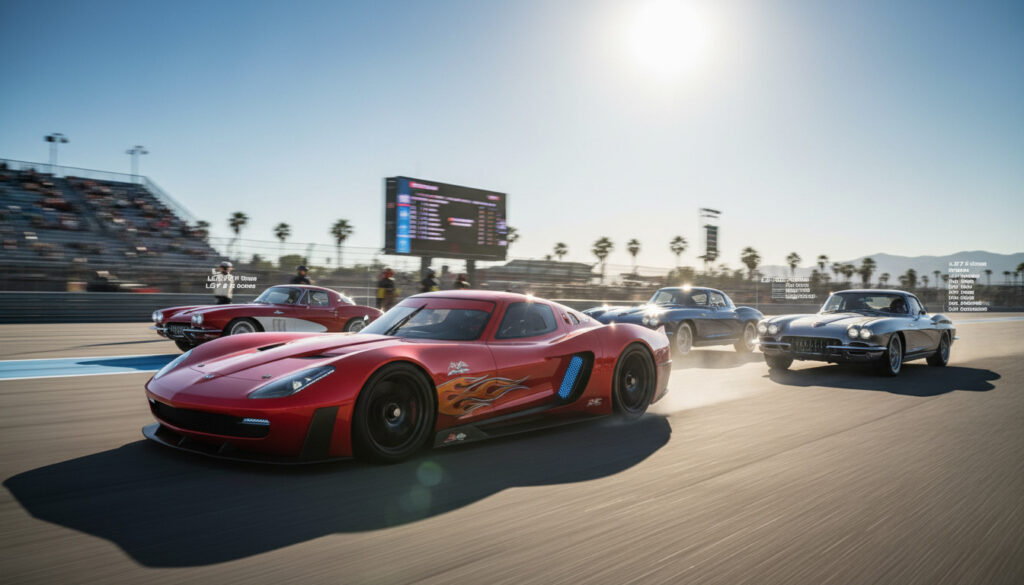
What Car Is Lightning McQueen – Model, Specs and Real Inspirations
Lightning McQueen stands as one of animation’s most recognizable automobiles, a fiery red racer sporting the number 95 and an attitude as bold as his paint scheme. Since his debut in Pixar’s 2006 film Cars, audiences have questioned whether this anthropomorphic stock car represents a specific production model or exists as a purely fictional synthesis of automotive design.
The character embodies a deliberate hybrid approach. His proportions and styling cues draw heavily from American racing heritage, particularly the Generation 4 NASCAR stock cars prevalent in the mid-2000s and the Chevrolet Corvette C6.R sports car. Yet McQueen conforms to no single manufacturer’s specification sheet, instead representing a creative fusion engineered for cinematic storytelling.
Understanding his automotive classification requires examining the official design partnerships, evolution across three feature films, and the specific mechanical specifications attributed to this Piston Cup competitor.
What Kind of Car is Lightning McQueen?
- McQueen is not a licensed production vehicle but a custom digital creation by Pixar’s design team.
- His architecture merges Generation 4 NASCAR stock car silhouettes with Corvette C6.R sports car proportions.
- Pixar partnered directly with Chevrolet during development to base his dimensions on the 2005 C6 Corvette platform.
- The design incorporates influences from 1960s Le Mans winners including the Ford GT40 and Lola T70 prototypes.
- No single real-world automobile matches McQueen’s complete specification due to anthropomorphic animation requirements.
- His engine sound replicates the low-tech pushrod V8 note characteristic of the Corvette C6.R race car.
- The character’s appearance evolved across three films, eventually integrating NASCAR’s controversial “Car of Tomorrow” aerodynamic elements.
| Attribute | Fictional Specification | Real-World Inspiration |
|---|---|---|
| Body Style | Stock Car | Chevrolet Corvette C6 / Gen 4 NASCAR |
| Racing Number | 95 | NASCAR custom numbering conventions |
| Engine | 5.8L V8 | GM LS7 / C6.R pushrod V8 |
| Horsepower | 750 hp | High-performance racing output |
| Acceleration | 0-60 mph in 4 seconds | Supercar performance range |
| Top Speed | 200+ mph | Corvette ZR1 (~210 mph) |
| First Appearance | 2006 (Cars) | C6 Corvette debut era (2005) |
| Primary Sponsor | Rust-eze | Fictional brand |
| Chassis Architecture | Stock car silhouette | NASCAR Gen 4 platform |
| Roofline Design | Swooping coupe profile | Porsche 911 influences |
Is Lightning McQueen Based on a Real-Life Car?
Motor Trend confirms that McQueen represents an original custom-built design rather than a direct replica of any single production vehicle. His bodywork fuses multiple automotive influences onto a C6 Corvette-derived proportion base, creating a unique entity that exists solely within the animated universe.
The Chevrolet Corvette Connection
During early development, Pixar established a formal partnership with Chevrolet to ensure McQueen’s proportions aligned with the then-new 2005 C6 Corvette. GM Authority notes that designers specifically referenced the C6.R racing variant built by Pratt & Miller, incorporating its sleek GT bodywork and distinctive pushrod V8 engine acoustics into the character’s animation.
NASCAR Stock Car Foundations
The character’s flat, wide silhouette and front fascia derive primarily from Generation 4 NASCAR stock cars, particularly the Chevrolet Monte Carlo models prevalent when the original film released in 2006. This NASCAR foundation provided the aerodynamic profile necessary for the Piston Cup racing narrative while grounding the character in contemporary American motorsport aesthetics.
Additional Racing Heritage Elements
Beyond the Corvette and NASCAR foundations, McQueen’s design incorporates subtle nods to endurance racing history. His roofline echoes the Porsche 911, while rear styling hints at the Dodge Viper. The design team also drew inspiration from 1960s Le Mans prototypes, specifically the Ford GT40 and Lola T70, contributing to the character’s timeless racing aesthetic.
Pixar collaborated directly with Chevrolet during development to ensure McQueen’s proportions mirrored the then-new 2005 C6 Corvette, though the final design intentionally blends multiple brands to maintain uniqueness.
No production vehicle matches McQueen exactly. His design prioritizes anthropomorphic animation requirements—such as expressive windshield eyes and mouth placement—over precise mechanical replication of any single real-world automobile.
Automotive enthusiasts have constructed tribute vehicles, including a modified 2005 C6 Corvette dubbed the “Supervette” that emulates McQueen’s distinctive livery and body modifications. Corvette Forum documents one such build process.
What Are Lightning McQueen’s Key Specifications?
Within the fictional universe of the Cars franchise, Lightning McQueen competes in the Piston Cup series with specific performance attributes that reflect his high-caliber racing pedigree. These specifications blend realistic automotive engineering with animated exaggeration.
Performance Capabilities
Technical breakdowns of the franchise indicate McQueen operates a 5.8-liter V8 engine producing approximately 750 horsepower. This powerplant enables acceleration from 0 to 60 mph in roughly 4 seconds, with top speeds exceeding 200 mph during Piston Cup competition. These figures place him in the upper echelon of racing performance, comparable to real-world GT1 and NASCAR Cup Series vehicles.
Racing Identity and Livery
McQueen campaigns under the number 95, a digit chosen for its visual symmetry and branding potential within the narrative. His signature red paint scheme promotes the fictional Rust-eze bumper ointment company, establishing his identity as the “Rust-eze Racing Center” competitor before his character arc introduces alternative sponsorships in subsequent films.
Voice Characterization
Lightning McQueen’s voice actor, Owen Wilson, contributes significantly to the character’s identity across all three films. Wilson’s vocal performance captures the protagonist’s initial arrogance and subsequent humility, creating an auditory signature as distinctive as the engine notes animated for the character. Endurance Warranty confirms Wilson’s continued involvement throughout the franchise.
How Did Lightning McQueen’s Design Evolve Across the Cars Franchise?
-
Original design established with Generation 4 NASCAR base proportions combined with C6.R Corvette and 1960s GT flair. McQueen appears as a rookie hotshot learning humility in Radiator Springs.
-
Minor aesthetic tweaks updated McQueen’s appearance to match contemporary NASCAR styling of the era while maintaining core design elements. The character participates in the World Grand Prix spy adventure narrative.
-
Significant updates included a raised rear wing resembling the late-2000s/early-2010s “Car of Tomorrow” NASCAR specifications, controversial among fans for altered aerodynamics. Design analysis indicates additional nods to the older Corvette C1. The narrative portrays McQueen as an aging veteran mentoring next-generation racer Cruz Ramirez.
What Is Definitively Known Versus Uncertain About McQueen’s Design?
| Established Information | Uncertain or Misconceived Details |
|---|---|
| Hybrid design combining Gen 4 NASCAR architecture with C6 Corvette proportions | Exact year model designation (frequently misidentified as a specific 2006 or 2007 production vehicle) |
| Official Pixar-Chevrolet partnership during 2005-2006 development | Specific horsepower figures in fictional versus real-world contexts (750 hp cited in-universe, but real C6.R produced approximately 500-600 hp) |
| Number 95 racing livery and Rust-eze sponsorship | Whether Rust-eze represents a real-world product (it is entirely fictional) |
| Owen Wilson’s voice performance across all three films | Precise mechanical specifications of the “Piston Cup” racing series regulations |
| Incorporation of Ford GT40 and Lola T70 design influences | Exact top speed capabilities in different racing scenarios (200+ mph implied but not officially calibrated) |
What Cultural Context Shaped Lightning McQueen’s Creation?
Lightning McQueen occupies a unique position at the intersection of American motorsport culture and animated storytelling. His design bridges the gap between the oval-track dominance of NASCAR and the international prestige of sports car racing, reflecting Pixar movie inspirations that draw from diverse automotive histories.
The character’s evolution from rookie sensation to aging mentor across three films mirrors real-world athletic careers, while his mechanical design pays homage to an era of racing that valued raw mechanical grip over modern aerodynamic complexity. This cultural positioning allows McQueen to appeal simultaneously to NASCAR enthusiasts familiar with Gen 4 stock cars and sports car aficionados who recognize the C6.R influences.
His enduring popularity has generated significant aftermarket interest, with fans attempting to recreate the vehicle despite the absence of an official licensed replica. This phenomenon underscores the character’s impact on automotive culture, transcending his animated origins to influence real-world car culture and collectibles markets.
What Do Primary Sources Confirm About McQueen’s Origins?
Multiple authoritative sources confirm the hybrid nature of McQueen’s design. Motor Trend’s analysis establishes that while McQueen utilizes C6 Corvette proportions, he is not a direct replica of any single real-life model. Similarly, GM Authority documents the Pixar-Chevrolet partnership that influenced his early development.
McQueen represents a custom-built racing car design primarily inspired by mid-2000s Generation 4 NASCAR stock cars, with significant influences from the Chevrolet Corvette C6.R.
— Motor Trend and GM Authority design analysis
What Defines Lightning McQueen’s Automotive Identity?
Lightning McQueen ultimately defies simple categorization as either a stock car or a sports car, existing instead as a purpose-built animated character whose design synthesizes Generation 4 NASCAR silhouettes, Chevrolet Corvette C6.R proportions, and endurance racing heritage from the 1960s. His number 95 livery, 750-horsepower V8 specifications, and Owen Wilson’s vocal performance combine to create an automotive icon that transcends his fictional origins, influencing both popular culture and real-world automotive enthusiasm despite having no exact physical counterpart.
Frequently Asked Questions
Who provides the voice for Lightning McQueen?
Owen Wilson voices Lightning McQueen across all three films in the franchise, delivering the character’s distinctive blend of confidence and vulnerability.
What racing number does Lightning McQueen use?
McQueen campaigns under number 95 throughout the Piston Cup series, displayed prominently on his doors and roof in his signature red livery.
Is Lightning McQueen officially a Chevrolet Corvette?
No. While Pixar partnered with Chevrolet to base his proportions on the C6 Corvette, McQueen is a custom creation incorporating NASCAR and other racing influences, not an official Corvette model.
What engine powers Lightning McQueen?
The character is depicted with a 5.8-liter V8 engine producing 750 horsepower, with acoustic properties modeled after the pushrod V8 in the Corvette C6.R race car.
Does a real-life version of Lightning McQueen exist?
No factory-produced McQueen exists, though fans have created tribute builds such as the “Supervette,” a modified 2005 C6 Corvette featuring McQueen’s livery and styling cues.
How has Lightning McQueen’s appearance changed over the films?
The character received minor updates in Cars 2 (2011), then significant revisions in Cars 3 (2017) including a raised rear wing resembling NASCAR’s “Car of Tomorrow” design.
What is Lightning McQueen’s top speed?
Fictional specifications indicate top speeds exceeding 200 mph, though precise figures vary by narrative context within the racing sequences.
More related posts
 Sekiro Shadows Die Twice – Guide to Platforms and Difficulty
 163 cm in Feet – Exact Conversion and Growth Guide
 Ray Winstone – Biography, Movies, Net Worth and Wife 2025
 Day 1 Chicken Pox Adults – Symptoms Before Rash
 Alexis Bledel – Biography, Age, Height, Husband, and Parents
 Philip Kingsley – Science-Backed Hair Care Since the 1960s
 Camping and Caravan Club – Complete UK Guide for 2025
 Lily Savage – Biography Death and TV Career