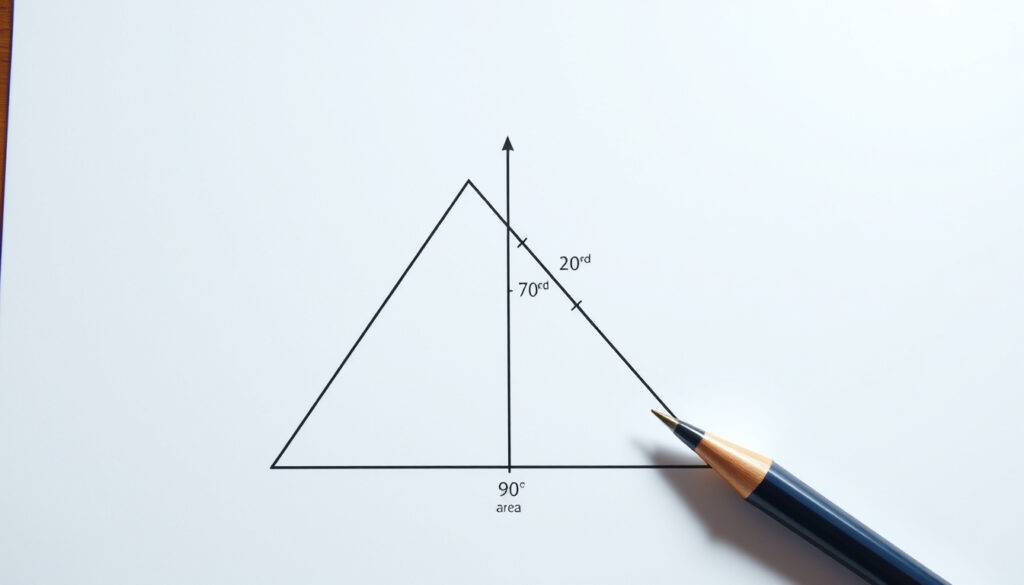
Right Angle Triangle Calculator – Solve Sides, Angles and Area
Right Angle Triangle Calculator – Solve Sides, Angles & Area
A right angle triangle calculator is an online tool that solves for missing sides, angles, area, and perimeter of a right-angled triangle. By entering any two known values—such as two side lengths or one side plus an angle—these calculators apply the Pythagorean theorem and trigonometric functions to deliver instant results. The tools are freely accessible through platforms like calculator.net, Pearson, Omni Calculator, and others, requiring no registration to use.
These calculators handle inputs in both degrees and radians, making them versatile for academic, professional, and hobbyist purposes. Construction workers use them to verify roof pitches, surveyors rely on them for measurement projections, and students employ them to check homework answers. The underlying mathematics traces back to ancient Greece, where the Pythagorean theorem established the relationship between the sides of a right triangle.
Understanding how these tools function begins with recognizing the geometric principles they implement. The Pythagorean theorem states that the square of the hypotenuse equals the sum of squares of the two legs, while trigonometric functions sine, cosine, and tangent relate angles to side ratios. Together, these formulas enable complete solutions for any right triangle given minimal input.
How Do You Calculate the Hypotenuse and Missing Sides?
- The hypotenuse (side c) must always be longer than either leg—calculators flag impossible inputs automatically.
- For sides a=3 and b=4, the calculator computes c=5 using the Pythagorean theorem.
- When given hypotenuse c=10 and angle A=30°, the tool derives a=5 and b≈8.66.
- Common error: entering the hypotenuse as a leg input, which produces mathematically invalid results.
- Trigonometric extensions allow calculations beyond basic side lengths using sine and cosine functions.
- Area and perimeter calculations provide additional metrics for comprehensive triangle analysis.
- Tools require at least one side length or area value for full computation.
| Formula | Description | Example |
|---|---|---|
| Hypotenuse: c = √(a² + b²) | Longest side from two legs | a=3, b=4 → c=5 |
| Leg from hypotenuse: a = √(c² − b²) | Missing leg calculation | c=10, b=6 → a=8 |
| Area: (a × b) / 2 | Half product of legs | a=3, b=4 → area=6 |
| Perimeter: a + b + c | Sum of all sides | 3+4+5 → 12 |
| Tangent: tan(α) = opp/adj | Angle from side ratios | a=3, b=4 → α≈36.87° |
| Sine: sin(α) = opp/hyp | Opposite over hypotenuse | a=3, c=5 → α≈36.87° |
| Cosine: cos(α) = adj/hyp | Adjacent over hypotenuse | b=4, c=5 → α≈36.87° |
| Complementary angles: β = 90° − α | Find the second acute angle | α=30° → β=60° |
What Formulas Are Used in a Right Triangle Calculator?
Every right triangle possesses one 90° angle, with the two remaining angles summing to 90° and earning the designation of complementary angles. This fundamental property shapes how calculators approach angle-based computations.
The Pythagorean Theorem
The Pythagorean theorem serves as the cornerstone of right triangle calculations. It establishes that for a right triangle with legs a and b and hypotenuse c, the relationship a² + b² = c² always holds true. This formula appears across virtually all right triangle calculators, from simple web-based tools to advanced engineering software. The theorem enables calculations whether the input involves two legs, one leg and the hypotenuse, or the hypotenuse alone.
When solving for the hypotenuse, the calculator computes the square root of the sum of squared legs. When solving for a missing leg, it rearranges the formula to isolate the unknown variable, computing the square root of the difference between the squared hypotenuse and the known leg. These operations execute instantly, providing results that would otherwise require manual calculation and verification.
Calculators handle both radians (e.g., π/3) and degrees, allowing users to work in their preferred unit system. Inverse trigonometric functions like α = arcsin(a/c) or α = arctan(a/b) convert side ratios back into angle measurements.
Trigonometric Functions
Beyond the Pythagorean theorem, trigonometric functions extend a right triangle calculator’s capabilities significantly. Three primary functions relate angles to side ratios:
- Sine (sin): The ratio of the opposite side to the hypotenuse, expressed as sin(α) = a/c.
- Cosine (cos): The ratio of the adjacent side to the hypotenuse, expressed as cos(α) = b/c.
- Tangent (tan): The ratio of the opposite side to the adjacent side, expressed as tan(α) = a/b.
These functions allow calculators to determine angles when side lengths are known, or to find missing sides when angles and one side are provided. The relationship between trigonometric functions and the Pythagorean theorem creates a comprehensive solving framework that handles virtually any input combination.
How to Use a Right Angle Triangle Calculator Step-by-Step?
Using a right angle triangle calculator involves a straightforward three-step process that delivers immediate, accurate results. Most tools follow identical procedures regardless of the platform, though the interface may vary slightly between different websites.
Step 1: Enter Your Known Values
Begin by inputting two values into the calculator. Acceptable input combinations include two side lengths (such as sides a=3 and b=4), the hypotenuse plus one leg, or one side plus an angle. Some calculators accept area as an input for deriving side lengths. Ensure values are positive numbers; negative or zero inputs typically generate error messages.
Step 2: Select Units and Click Calculate
Choose your preferred angle measurement unit—degrees or radians—before activating the calculation. Click the calculate button or its equivalent, and the tool processes your inputs through its built-in formulas. Results appear instantly, typically displaying all unknown sides, both acute angles, the area, and the perimeter.
Step 3: Review Your Results
Examine the computed values, which most calculators present in organized tables or lists. Step-by-step explanations often accompany the results, showing the formulas applied and intermediate calculations performed. This transparency helps users verify accuracy and understand the mathematical process.
The hypotenuse (side c) must always exceed either leg in value. If your inputs suggest otherwise, the calculator will indicate an invalid configuration. Additionally, the three interior angles must sum to 180°, with one angle fixed at exactly 90°.
What Are the Key Properties of a Right-Angled Triangle?
Right-angled triangles possess distinctive properties that distinguish them from other triangle types and enable the specialized calculations these tools perform. Understanding these properties helps users interpret results correctly and apply the calculators appropriately.
Geometric Fundamentals
A right triangle contains exactly one right angle measuring 90°. The side opposite this right angle—the hypotenuse—always represents the longest side. The two sides forming the right angle are called legs or catheti. These geometric constraints define the valid input ranges for calculators and ensure consistent mathematical behavior.
The relationship between the angles deserves particular attention. Since the interior angles of any triangle sum to 180°, and one angle is fixed at 90°, the remaining two angles must sum to 90°. This complementary relationship means that finding one acute angle automatically determines the other through the formula β = 90° − α.
When using these calculators, verify that your computed angles sum to 180° (including the right angle) and that the hypotenuse value exceeds each leg. Any violation of these rules indicates an input error requiring correction.
Real-World Applications
Right triangle calculators serve numerous practical purposes across diverse fields. In construction, these tools verify roof pitches, calculate stair dimensions, and ensure structural elements meet proper angles. Surveyors employ them for distance and elevation measurements where direct measurement proves impractical. Navigation systems incorporate right triangle trigonometry for position calculations, while architects rely on these principles when designing buildings and infrastructure.
Common reference triangles simplify everyday calculations. The 3-4-5 triangle produces a hypotenuse of exactly 5, making it useful for quick verification of right angles on job sites. Similarly, the 5-12-13 triangle offers another easily remembered ratio. These standardized configurations appear frequently in educational contexts and practical applications alike.
A Brief Historical Context
The mathematical principles underlying right triangle calculators date to approximately 500 BCE, when the Pythagorean theorem was documented by followers of the ancient Greek mathematician Pythagoras. While evidence suggests Babylonian and Indian mathematicians understood similar relationships earlier, Pythagoras and his school formalized the geometric proof that continues to underpin modern calculations.
The theorem remained primarily a geometric curiosity for centuries, applied mainly in land measurement and early architecture. The development of trigonometry expanded its utility, and the invention of computing devices in the 20th century automated the calculations that once required tables and manual computation.
More related posts
 Law & Order: SVU Episodes – Complete Guide to All 27 Seasons
 Chinese Yen to GBP – Live Rate and Conversion Guide
 Olivia Attwood Love Island – From Contestant to TV Star
 Tax Free Childcare Calculator – Check Your Top-Up & Eligibility
 Sheila Fearn – Actress Biography and What We Know in 2025
 Ray-Ban Meta Glasses – Features, Price, Review Guide
 Mariah Carey – Biography, Age, Children and Iconic Songs
 Charli Xcx – Biography, Songs and 2025 Tour Updates