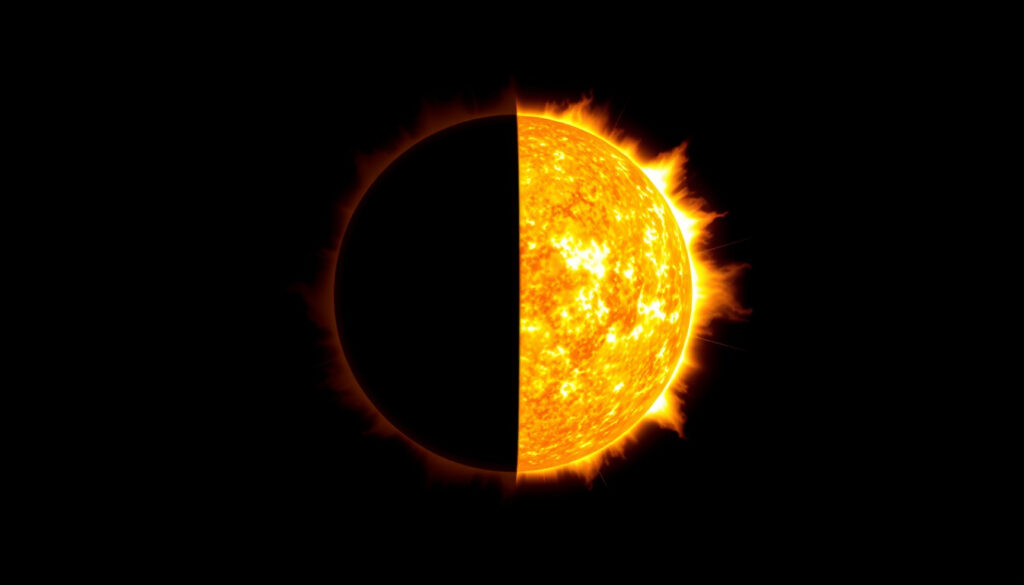
How Hot Is the Sun – Core, Surface and Corona Temperatures
How Hot is the Sun? Surface, Core Temps in Celsius, Fahrenheit & Kelvin
The Sun’s temperatures span an extraordinary range, from roughly 15 million °C in its core to millions of degrees in the outer atmosphere. Understanding these extreme temperatures reveals how nuclear fusion powers our solar system and why the corona paradoxically burns hotter than the visible surface.
For most observers, the Sun appears as a uniformly bright disk. However, scientists recognize a complex layered structure, with temperatures that vary dramatically depending on which region is measured. This guide breaks down what we know about solar temperatures across every layer.
How Hot is the Surface of the Sun?
The photosphere represents what we commonly perceive as the Sun’s surface, though it is actually a layer of hot plasma approximately 300–500 km thick. This is the zone that emits the sunlight visible to the naked eye.
Temperatures here average around 5,800 K (5,500 °C or 10,000 °F), though measurements vary by altitude within the layer. The bottom of the photosphere reaches approximately 6,500 K, while the cooler upper regions drop to about 4,000 K.
Sun Temperature Overview by Layer
| Layer | Temperature (Kelvin) | Celsius | Fahrenheit |
|---|---|---|---|
| Core | ~15,000,000 K | ~15,000,000 °C | ~27,000,000 °F |
| Photosphere | ~5,800 K | ~5,500 °C | ~10,000 °F |
| Chromosphere | 4,000–20,000 K | 3,700–20,000 °C | 6,700–36,000 °F |
| Corona | 1,000,000–3,500,000 K | 1,000,000–3,500,000 °C | 1,800,000–6,300,000 °F |
Key Facts About Solar Temperatures
- The photosphere emits most of the sunlight that reaches Earth, appearing as the Sun’s visible surface
- Temperatures increase dramatically moving outward from the photosphere into the corona
- NASA’s Solar Dynamics Observatory continuously monitors temperature variations across solar layers
- Granules visible on the photosphere represent convection cells of hot plasma
- The corona can reach temperatures 500 times hotter than the photosphere below it
- Short-term temperature changes on the Sun are minimal, varying by less than 1% over cycles
Scientists use spectroscopy to measure solar temperatures from Earth. Each element emits light at specific wavelengths corresponding to its temperature, allowing precise readings without direct contact.
What is the Temperature of the Sun’s Core?
The Sun’s core represents the hottest region of our star, where temperatures reach approximately 15 million degrees Celsius (27 million °F or 15 million K). This extreme heat, combined with crushing pressure roughly 150 times denser than water, enables nuclear fusion to occur.
Within this central region, hydrogen atoms fuse into helium through a process described by Einstein’s equation E=mc². Roughly 600 million tons of hydrogen undergo fusion each second, with about 4 million tons converted directly into energy.
The energy produced in the core does not escape immediately. Photons generated by fusion take between 40,000 and 1 million years to travel through the radiative and convective zones before escaping through the photosphere into space.
Layers Below the Surface
Between the core and photosphere lie two distinct zones that transport energy outward. The radiative zone extends from the core to roughly 70% of the Sun’s radius, where energy moves outward through photon absorption and emission.
Beyond this, the convective zone reaches from approximately 70% of the radius to just below the photosphere. Here, hot plasma rises like boiling water, carrying thermal energy toward the surface through convection currents.
The Sun does not “burn” in the way a fire does. Combustion requires oxygen, which does not exist in significant quantities in space. Instead, the Sun operates through nuclear fusion, a process that combines atomic nuclei under extreme heat and pressure.
Sun Temperatures in Celsius, Fahrenheit, and Kelvin
Scientists typically express solar temperatures in Kelvin (K), the standard unit for astronomical measurements. The conversion to Celsius follows a straightforward formula: °C = K − 273.15. For Fahrenheit, the calculation is °F = (°C × 9/5) + 32.
At the photosphere, where we observe 5,800 K on average, this translates to approximately 5,527 °C or 9,980 °F. The core’s 15 million K corresponds to roughly 15 million °C or 27 million °F.
Atmospheric Layer Temperatures
Beyond the photosphere, temperatures behave counterintuitively. The chromosphere, the thin red layer visible during eclipses, ranges from 4,000 K at its base to 8,000–20,000 K at its upper boundary.
The transition region spanning merely 60–100 km experiences a dramatic temperature jump from 8,000 K to over 500,000 K. Scientists continue studying this rapid escalation to understand the underlying mechanisms.
The corona, extending millions of kilometers into space, maintains temperatures between 500,000 and 3.5 million K. This region remains visible only during total solar eclipses or through specialized coronagraph instruments.
One of solar physics’ enduring mysteries involves the coronal heating problem. The corona sits farther from the Sun’s energy source than the photosphere, yet reaches temperatures up to 500 times greater. Researchers propose that magnetic waves from sunspots may channel energy upward, though the exact mechanism remains under investigation.
Is the Sun Always This Hot? Addressing Common Questions
Does the Sun Cool Down at Night?
The Sun does not experience day-night cycles like Earth. While the Sun rotates on its axis (completing one rotation roughly every 27 days at the equator), this rotation does not significantly alter overall temperatures.
Solar activity does fluctuate over approximately 11-year cycles, affecting the frequency of sunspots and coronal mass ejections. However, these cycles produce minimal changes to average temperatures, remaining within 1% of baseline values.
How Cold is Space Around the Sun?
Space itself lacks a temperature in the traditional sense, as temperature measures the motion of particles within a substance. However, objects in space near Earth maintain temperatures based on their distance from the Sun and exposure to solar radiation.
The side of an object facing the Sun absorbs energy and heats up, while the shadowed side radiates heat away into space. Without an atmosphere to distribute warmth evenly, objects in space experience extreme temperature differences between sunlit and dark surfaces.
Does the Photosphere Have a Solid Surface?
The photosphere is not solid in any conventional sense. It consists entirely of ionized plasma gas, approximately 300 km “thick” from top to bottom. Unlike planets with defined surfaces, the Sun transitions gradually from dense plasma to the vacuum of space.
What Do Scientists Know for Certain—And What Remains Unclear?
| Established Information | Remaining Uncertainties |
|---|---|
| Core temperature approximately 15 million K, determined through theoretical models and spectroscopy | Maximum temperature of the corona varies by region and remains debated |
| Photosphere averages 5,800 K, measured through spectral analysis | Precise heating mechanism in the transition region not fully understood |
| Fusion processes convert hydrogen to helium, confirmed through neutrino detection | How magnetic waves transfer energy to heat the corona requires further study |
| Corona is significantly hotter than the surface below it | Variation in temperature across different coronal features |
The Sun in Context: Why Do Temperature Layers Differ?
The Sun’s layered temperature structure results from the balance between energy production and transport mechanisms. In the core, nuclear fusion generates enormous heat continuously. Energy then propagates outward through two distinct mechanisms: radiation in the inner zones and convection in the outer layers.
The counterintuitive temperature rise in the atmosphere stems from magnetic field interactions. As plasma moves through the Sun’s magnetic field, energy transfers upward into the corona. Scientists observe this process through the Solar Dynamics Observatory and other space-based telescopes.
These temperature variations directly impact Earth. The Sun’s heat drives our weather systems, while solar wind and radiation affect satellites, power grids, and radio communications. Understanding solar behavior helps us prepare for space weather events.
Understanding Solar Temperatures: Scientific Sources
NASA serves as the primary authority on solar science, maintaining continuous observations through multiple spacecraft including the Solar Dynamics Observatory. The High Altitude Observatory at the National Center for Atmospheric Research provides complementary research on solar physics.
The core is the engine of the Sun, producing the energy that eventually reaches Earth as sunlight. Understanding this process helps us appreciate both our star’s power and its influence on our planet.
— NASA Science Editorial Team
Independent verification comes from ground-based observatories and international space agencies. Spectroscopic measurements from multiple institutions consistently confirm the temperature ranges documented by NASA and leading research centers.
Summary: Key Takeaways on Solar Temperatures
The Sun’s temperatures span an extraordinary range, from 15 million °C in its core to millions of degrees in the corona. The visible surface (photosphere) measures approximately 5,500–6,200 °C, while the outer atmosphere paradoxically reaches temperatures hundreds of times greater. Scientists confirm these measurements through spectroscopy and space-based observations, though the mechanism behind coronal heating remains an active area of research.
These extreme temperatures result from nuclear fusion in the core, where hydrogen converts to helium and releases enormous energy. This energy takes tens of thousands of years to travel outward before escaping into space as sunlight.
The Sun’s heat affects every aspect of our planet, from climate to communications. Comparing Hottest Temperature Ever Recorded on Earth to solar temperatures highlights how modest our planet’s extremes truly are.
Frequently Asked Questions
How hot is the Sun for kids?
The Sun’s core reaches about 15 million degrees, like an incredibly hot oven. The visible surface is cooler at around 6,000 degrees. Scientists compare it to a giant peach—the pit (core) is hottest, the flesh (interior) is warm, and the skin (photosphere) glows brightest.
How hot is the surface of the Sun?
The photosphere, what we see as the Sun’s surface, averages about 5,800 K (5,500 °C or 10,000 °F). The bottom runs hotter at around 6,500 K, while the upper regions cool to about 4,000 K.
What is the hottest part of the Sun?
The core reaches approximately 15 million K (15 million °C or 27 million °F). This extreme heat enables hydrogen atoms to fuse into helium, releasing the energy that ultimately becomes sunlight.
Why is the corona hotter than the Sun’s surface?
Scientists believe magnetic waves originating from sunspots channel energy upward into the corona. The exact mechanism remains under investigation, but magnetic field interactions appear to transfer heat against the normal temperature gradient.
How hot is the Sun in space compared to Earth?
Space itself has no meaningful temperature. However, objects near Earth receive intense solar radiation, heating sunlit surfaces to over 100 °C while shadowed surfaces drop to around -100 °C or lower.
Does the Sun have a solid surface?
No. The photosphere consists entirely of ionized plasma gas roughly 300–500 km thick. There is no solid boundary like a planet’s surface, only a gradual transition from dense gas to the vacuum of space.
How long does it take for solar energy to reach Earth?
Light travels from the photosphere to Earth in about 8 minutes. However, energy generated in the core takes 40,000 to 1 million years to travel through the Sun’s interior before escaping as sunlight.
How does the Sun’s temperature compare to other stars?
The Sun falls in the middle range for stars. Red dwarfs may reach only 3,000–4,000 K, while blue giants can exceed 30,000 K. The Sun’s 5,800 K surface temperature makes it a yellow dwarf, though it appears white from space.
More related posts
 Corn Exchange King’s Lynn – Seating Plan, Events and Panto Guide
 Mariah Carey – Biography, Age, Children and Iconic Songs
 How Old I David Attenborough – 100th Birthday, Family and Life
 Takeaways Near Me Open Now – Smart Guide to Local Delivery
 Pattie Boyd – Biography, Age, Book, and Relationships
 Rachel Stevens – Net Worth, Family and Life in 2025
 Actual Breast Cancer Lump – What It Feels Like and When to Worry
 London North Eastern Railway – Essential Guide for Travellers