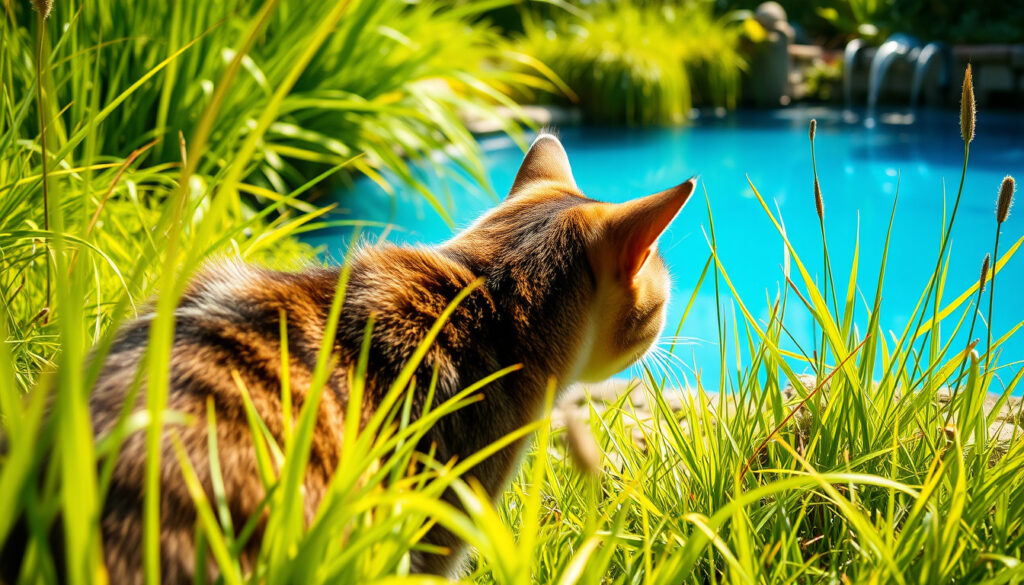
What Colours Can Cats See – Blues and Yellow-Greens Vivid
For decades, pet owners assumed cats perceived the world in shades of gray. Modern research has fundamentally reshaped that understanding. Cats do not see the world in black and white—they perceive a narrower spectrum of colours, dominated by blues and yellow-greens, while reds, oranges, pinks, and purples appear muted or grayish. This dichromatic vision reflects millions of years of evolutionary adaptation for hunting in low-light conditions rather than appreciating vibrant hues.
Understanding how feline eyes work helps explain these limitations. A cat’s retina contains specialised light-sensing cells called cones and rods. Cones handle colour discrimination and daylight vision, while rods excel in dim conditions and detect motion. The balance between these cell types shapes what a cat sees moment to moment. Scientists have confirmed through behavioural studies and neural recordings that cats distinguish certain colours while remaining effectively colour-blind to others.
What colours do cats see best?
Research consistently shows that cats distinguish blue and yellow-green wavelengths most effectively. These hues appear vivid to cats, comparable to how humans perceive red or green. The retinas of domestic cats contain three cone types—blue-sensitive, green-sensitive, and possibly yellow-sensitive—enabling them to discriminate colour across specific ranges, though with less vividness than human vision.
Blue
Seen clearly, especially blue-violet tones
Yellow-Green
Perceived with reasonable clarity
Red-Orange
Appear as gray or muted tones
Low-Light
Vision up to 8× better than humans
The 1970s research conducted by scientists remains foundational to this understanding. Studies involving cats trained to discriminate colours at various light levels demonstrated that the animals retained their colour-discriminating ability even after rods became saturated. Neural recordings from the lateral geniculate nucleus—an area of the brain processing visual information—showed opponent-colour units responding from blue and green cones, confirming that multiple cone types contribute to feline colour vision.
- Cats possess dichromatic vision, perceiving primarily blue and yellow-green hues
- Cone sensitivity peaks occur at approximately 450 nm, 500 nm, and 550 nm wavelengths
- Red, orange, pink, and purple appear gray or indistinct to feline eyes
- Human trichromatic vision contains roughly 10 times more cones than cat retinas
- Colour discrimination remains reliable across mesopic (dim) to photopic (bright) conditions
- Cat vision is not the black-and-white monochrome once believed
| Colour | Cat Perception | Human Equivalent |
|---|---|---|
| Blue | Vivid and clear | Similar to human perception |
| Yellow | Vivid and clear | Similar to human perception |
| Red | Gray or dull | Rich, vibrant red |
| Green | Gray or muted | Distinct green |
| Purple | Appears as blue | Distinct purple |
| Pink | Gray or very dull | Distinct pink |
What colours can cats see in the dark?
Cats navigate low-light environments with remarkable efficiency, seeing six to eight times better than humans in dim conditions. This ability stems from anatomical adaptations developed over millennia of crepuscular hunting—cats are most active during dawn and dusk when light levels fluctuate between bright and dark.
The tapetum lucidum and rod dominance
A key structure enabling superior night vision is the tapetum lucidum, a reflective layer positioned behind the retina. This layer bounces light back through photoreceptor cells, effectively giving rods a second chance to detect photons. The amplification can reach 40 percent, significantly boosting low-light sensitivity. The tapetum lucidum also produces the characteristic eyeshine visible when a cat’s eyes catch light in darkness.
Feline retinas contain up to eight times more rods than human retinas. These rod cells excel at detecting movement and shapes in dim conditions but respond poorly to colour information. When light levels drop, rods dominate visual processing while cone activity diminishes. This rod saturation in low light further reduces any remaining colour perception, leaving cats essentially seeing shades of gray at night.
Despite reduced colour perception in darkness, cats compensate with exceptional motion detection. A mouse moving at the edge of a garden at dusk registers clearly to a cat’s eye, even if the animal cannot distinguish the creature’s colour.
Peripheral vision and hunting adaptation
Cats possess a 200-degree peripheral vision range compared to 180 degrees in humans. This wider field of view aids in detecting prey and predators approaching from the sides. Vertical pupils further enhance depth perception and light control, allowing the iris to constrict or dilate rapidly as lighting conditions change.
Scientists at the National Center for Biotechnology Information have documented how rod density varies across the feline retina, concentrated most heavily in areas serving peripheral and low-light vision. This distribution reflects evolutionary priorities: detecting motion in dim conditions proved more survival-relevant than appreciating saturated hues.
How do cats see specific colours like pink, purple, white and yellow?
Can cats see yellow?
Cats perceive yellow clearly, alongside blue and cyan. Research confirms that yellow-green wavelengths around 550 nm fall within the peak sensitivity range of feline cones. However, scientists note some uncertainty regarding the exact nuances of yellow perception. The debate mirrors similar discussions about dog colour vision, where the precise shade discrimination remains incompletely characterised.
Can cats see purple?
Purple presents an interesting case because it combines red and blue wavelengths. Since cats perceive blue clearly but struggle with red, purple likely appears as a blue-shifted tone to feline vision. The colour may seem similar to standard blue or appear as a muted bluish-gray, depending on the specific purple hue and surrounding context.
Can cats see white?
White contains the full visible spectrum, but cats cannot process all those wavelengths simultaneously the way humans do. White surfaces reflect light across the entire colour range, yet feline dichromatic vision collapses this information. A white object probably appears as a bright gray or pale yellow to a cat, influenced by the surrounding colours and ambient light levels.
How do cats see pink?
Pink involves red wavelengths combined with white, and since cats detect red poorly, pink registers as a muted gray or washed-out tone. Behavioural studies demonstrate that cats show no particular attraction to pink objects, unlike their frequent interest in blue or yellow toys that move across their field of vision.
Laser pointers attract cats through motion detection rather than colour perception. The rapid movement and contrast against backgrounds engages feline prey drive independent of any specific hue the cat perceives.
What do cats see when they look at humans?
When a cat observes a human, the animal perceives a roughly similar shape and movement pattern, but with significant differences in visual clarity and colour. Humans appear less sharp to cats, whose visual acuity ranges from 20/100 to 20/200 compared to the standard 20/20 human baseline. A human face seen from across a room appears considerably blurrier to a cat than to another person.
Colour-wise, human skin tones—which contain red and yellow undertones—appear somewhat gray or muted to feline eyes. A flushed face might register as warmer than a pale complexion, but the nuanced colour variations humans appreciate remain largely invisible to cats. Hair colour similarly falls into either blue-yellow or gray categories depending on the specific shade.
Cats rely heavily on other senses—particularly smell and hearing—to identify humans. Visual cues supplement these sensory inputs rather than serving as the primary recognition mechanism. A cat approaching its owner likely combines visual familiar with auditory cues and scent signatures to confirm identity.
| Aspect | Cat Vision | Human Vision |
|---|---|---|
| Colour Range | Dichromatic (blue/yellow-green focus) | Trichromatic (full spectrum) |
| Visual Acuity | 20/100 to 20/200 | 20/20 |
| Low-Light Performance | 6-8× superior; tapetum lucidum | Inferior; no tapetum |
| Peripheral Vision | 200 degrees | 180 degrees |
| Motion Detection | Exceptional at distance | Good but inferior |
How certain is cat colour vision science?
Scientific consensus strongly supports the fundamental framework of feline dichromatic vision. Multiple independent studies using behavioural conditioning and neural recording techniques have converged on similar conclusions. Cats distinguish blue and yellow wavelengths reliably, while perceiving red, orange, pink, and purple as gray or muted tones.
The dichromatic nature of cat vision—meaning two types of colour-detecting cones rather than three—is firmly established. Their ability to see blue and yellow-green clearly, while struggling with red-orange wavelengths, has been replicated across numerous research settings and experimental approaches.
| Established Information | Remaining Uncertainties |
|---|---|
| Cats possess three cone types | Precise sensitivity of yellow cone type |
| Blue and yellow-green clearly perceived | Exact boundaries of green perception |
| Tapetum lucidum enhances low-light vision | Degree of UV sensitivity debated |
| Rods 8× more dense than human retinas | Individual variation in colour discrimination |
| Visual acuity 20/100 to 20/200 | How cats perceive mixed or pastel colours |
Why cats see limited colours
The evolutionary trajectory of feline vision prioritised survival traits over colour appreciation. Domestic cats descend from African wild cats and other species that thrived in low-light environments. Predators hunting nocturnal prey gained enormous advantages from enhanced motion detection and superior night vision, while colour discrimination offered minimal survival benefit.
The third cone type present in human vision—sensitive to red wavelengths—never evolved prominently in felines. This represents a biological trade-off: resources directed toward rod development and the tapetum lucidum came at the expense of colour-processing infrastructure. Cats developed exceptional sensitivity to movement and shapes in dim conditions, skills essential for ambush hunting, while sacrificing the ability to appreciate saturated red or pink tones.
Some researchers propose that cats may perceive ultraviolet wavelengths, similar to certain birds and insects. However, this hypothesis remains debated within the scientific community. The lens and other optical media in feline eyes may filter UV light, potentially preventing such wavelengths from reaching the retina even if cone sensitivity exists.
Expert sources on feline colour vision
Cats do not see colour in the way that humans do. Their colour vision is thought to be similar to a human who is colour blind. They can see shades of blue and green, but reds and pinks appear more greenish. Purple may look like another shade of blue.
While cats can’t see red, orange, or brown, they can see shades of blue, green, and yellow. Colours like purple and blue-violet appear as shades of blue to cats, while green appears as shades of greenish-blue or gray.
Contrary to popular belief, cats are not colour blind. Cats can see colour, although not as many colours as humans can see. They are best able to see blues and yellows.
— Purina
Test cat vision at home
Pet owners can observe feline colour perception through simple experiments. Offering toys in different colours—particularly blue, yellow, and red—and noting which ones attract the most attention provides informal evidence. Comparisons with human colour perception highlight how differently the world appears to cats and their owners.
Selecting bedding, scratching posts, and food bowls in blue and yellow tones may engage cats more effectively than red or pink alternatives. The visual environment influences enrichment and wellbeing, particularly for indoor cats spending their lives within domestic spaces. Blue and yellow toys against gray or white backgrounds create the strongest visual contrast for feline eyes.
Frequently asked questions
Do cats see in black and white?
No, cats do not see in black and white. They perceive blues and yellow-greens clearly, along with related shades like cyan and gray. Reds, oranges, pinks, and purples appear as gray or muted tones rather than vibrant colours.
What colours are most visible to cats?
Blue and yellow-green wavelengths register most clearly to feline vision. These colours create the strongest contrast and appear vivid even in moderate lighting conditions. Cyan and greenish-blue also fall within good perception range.
Can cats see in complete darkness?
Cats cannot see in complete darkness, but they navigate in extremely low light levels far better than humans. Their tapetum lucidum amplifies available light by up to 40 percent, providing functional vision in conditions where humans would see nothing.
Why can cats see better at night than humans?
Cats possess several night-vision advantages: a tapetum lucidum that reflects light through photoreceptors twice, rod cells eight times more concentrated than in human retinas, and vertical pupils that adjust rapidly to changing light levels. These adaptations enable hunting during dawn and dusk when their prey is most active.
Do cats see better than humans overall?
Cats outperform humans in specific visual tasks—low-light navigation, motion detection, and peripheral awareness—but lag behind in visual acuity and colour range. Their vision optimised for detecting movement in dim conditions rather than appreciating fine details or vibrant hues.
Can cats see purple?
Purple likely appears as a blue tone to cats since it combines red and blue wavelengths. Since cats perceive blue clearly but struggle with red, purple probably registers as similar to standard blue or as a muted bluish-gray shade.
What is a cat’s visual field?
Cats possess approximately 200 degrees of peripheral vision compared to 180 degrees in humans. This wider field of view aids in detecting approaching threats and hunting prey from the periphery without turning the head.
More related posts
 Samsung Galaxy Tab A9+ – 11-inch Specs UK Prices Deals
 Lily Savage – Biography Death and TV Career
 Khamzat Chimaev Next Fight – UFC 328 Vs Strickland Details
 How Much Is David Lloyd Membership – UK Prices and Tiers 2025
 Oscar Bobb – From City Academy to Fulham’s New Hope
 Lauren Bacall – Her Life, Films, Death, and Enduring Legacy
 What Car Is Lightning McQueen – Model, Specs and Real Inspirations
 Christmas Lights Near Me – UK Trails and Displays 2025